

Sarah runs an apparel store, ‘The Blue Leaf’. She has two outlets, which are managed easily, since she uses Vend as her POS system. Vend helps her manage and sync product orders and inventory, from both stores. Sarah has decided to take her business online, and is thinking of building a website. Considering of course that she will be building her website on WordPress, which plugin would you recommend Sarah use?
Certainly Sarah will need an eCommerce plugin, so we’ll want to suggest WooCommerce (no surprises there :D ). But Sarah would also need to sync her store information between WooCommerce and Vend.
[space]
WooCommerce and Vend Integration
Since WooCommerce inherently does not provide this feature, she can try searching for a WooCommerce extension which integrates with Vend. But she won’t find one, because there isn’t one. Vend is quite a popular system, and Sarah doesn’t not want to give up using that. Should she have to choose a different platform altogether?
[space]
Comparison: WooCommerce v/s Vend POS system
Let’s take a look at the features of Vend and WooCommerce.
| Feature | WooCommerce | Vend |
| Add Products | Yes | Yes |
| Add Customers | Yes | Yes |
| Create Orders | Yes | Yes |
| Payment Options | Yes | Yes |
| Inventory Management | Yes | Yes |
| View Reports | Yes | Yes |
| Use Barcode Scanners | No | Yes |
| Can work Offline | No | Yes |
| Shipping | Yes | No |
| Customer Rewards | Yes* | Yes |
[space]
If you notice, both differ, only in terms of operating offline, shipping, and the use of scanners. This is because WooCommerce is an online store solution. Thus, there needs to be an option to ship products. Unlike Vend, where the customer will be physically present to collect the order. Similarly, there isn’t a need for WooCommerce to support barcode scanners, during checkout. But apart from this, product data, customer account information, order details, stock management, is handled by both. This means that there is a possibility to sync data between the two, to create a single point of management.
This is great news for Sarah. This means we can certainly help her by providing an extension plugin to WooCommerce which integrates with the Vend POS software.
[space]
WooCommerce Extension for Vend
Instead of modifying WooCommerce, it is better to provide an extension plugin, which will handle the synchronization of data, between the two systems.
- The plugin will be built in such a way, that it will map the fields, between WooCommerce and Vend. Thus when the fields get updated in one system, the changes are reflected appropriately in the other.
- We have to use the Vend API to sync the data values.
[space]
Synchronization of Data
The product, customer, and order data needs to be in sync. This in turn will ensure that stock details and sales reports are also in accordance in both the systems.
Products
Product data will be synchronized based on Product SKU. If the product is added in Vend, it should be automatically added to your WooCommerce store as well. The product details such as Title (Product Name), Description, Product Tags, Categories (Product type, Product Vendor) Stock Units, and Image, will have to be synchronized.
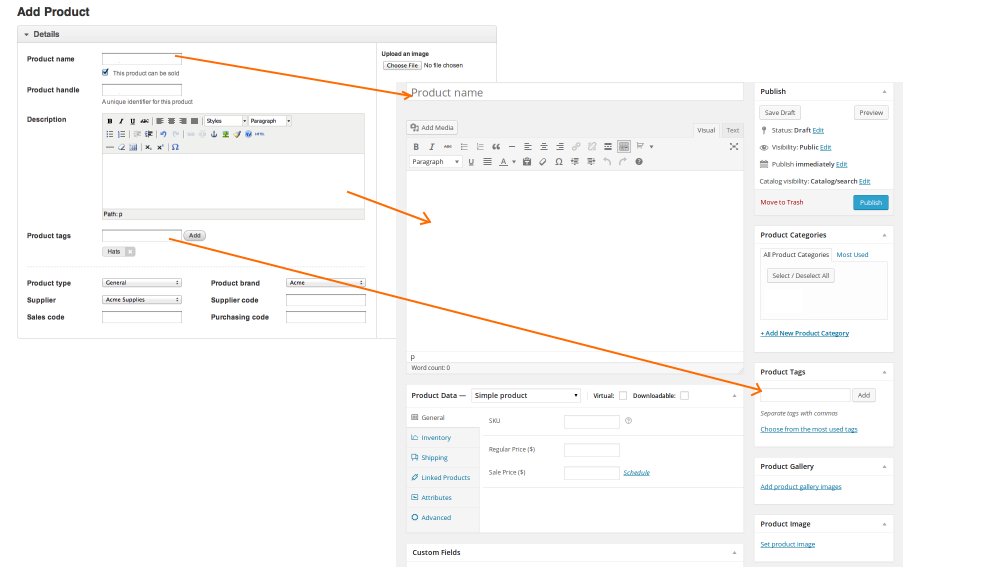
Simple product in WooCommerce will be added as a Standard Product in Vend. A Variable Product will be added as a Variant Product and a Product Bundle will have to be created for Composite Products.
Sale Prices and Coupons have to be set up as Price Books in Vend, and vice-versa.
Customer
To add a new customer, the minimum details you would need are the customer name, email address. If a customer is added in Vend, a new user has to be created on the WordPress site. If the customer’s postal address has been provided, this can be saved as the shipping address for the customer. Additional data added in Vend, can be saved as User Meta in WordPress.
Order
Order details have to be in accordance based on Order ID. Every time an order is made, the stock units have to be updated. The shipping details can be added as Order notes, in Vend.
[space]
What Happens when Store is Offline?
Since Vend can be used even when the system is offline. Orders can be created and purchases can be made in the retail store. There has to be a way provided which ensures, that when the store is back online, data on both the systems in synced in cases any purchases have been made. This can be done, by synchronizing data on a timely basis.
In addition, there needs to be a manual option to perform the sync as well. Since we will be creating the plugin as an add-on to WooCommerce, this option can be provided in the admin dashboard of the WordPress website.
[space]
Single Point of Management
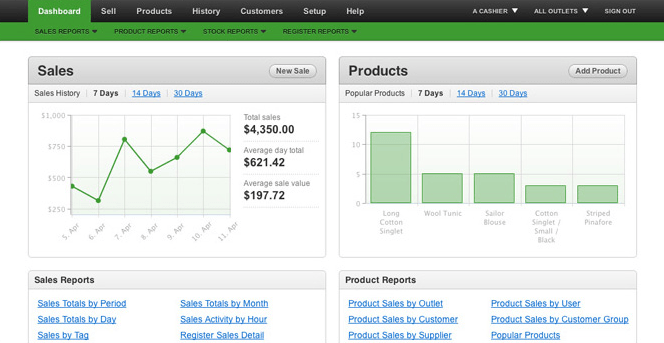
When we look at both WooCommerce and Vend, there isn’t a need to access the dashboards of both the systems. (Since anyway the data will be in sync). You can use only a single system to manage the store. Although, there are certain exceptions. For example, you have to access the WordPress dashboard to set shipping details, and shipping classes. Or to add different payment gateways or your SEO settings. Apart from such cases, you can surely do inventory management and view sales reports from a single (or rather either) dashboard.
[space]
What about WooCommerce Extensions?
Till this point, we hadn’t really considered what would happen if we were to support the several many extensions for WooCommerce. Considering the complexity of this extension plugin itself, the support for other extensions cannot be easily provided.
[space]
Conclusion
Coming to the conclusion of this article, even though there isn’t a plugin available to integrate WooCommerce and Vend, we can build one, because of the extensive API provided by Vend, and easy extension options for WooCommerce. And yes! As for Sarah, she can certainly run her online store smoothly on WordPress and WooCommerce and still continue using Vend.
[space]
Related Topics: Integrating WooCommerce and e-conomic Accounting System.