

After an LMS transition, most course businesses assume they owe their customers an announcement. They usually don’t.
The default should be silence. Disclosure needs an earned trigger: a customer asks, a service change becomes visible to users, or a competitor forces the conversation. And the right message depends on which state you’re in and how big your business is.
This is the customer communication playbook for that decision.
You’ve made your internal call on the LearnDash platform change: hold, watch, or move. Then the second question arrives, the one the other guides skipped. Do you tell your course customers anything about this?
Most operators don’t think about it until a customer emails first. By then the easy options are gone. So let’s work through what to say, what to leave unsaid, and how to scale the call to your business, whether you have 200 students or 50,000.
Why your first instinct about an LMS transition is probably wrong
Both common reactions to an LMS transition are wrong, and they’re wrong in opposite directions. A solo course creator tends to over-share. A larger operator tends to clam up. Neither is a reasoned decision. Both are just anxiety taking the wheel.
The over-sharer fires off a friendly heads-up: “Hey, just so you know, the platform we use changed hands…” It feels honest. It also adds to the worry of people who don’t have one.
The large operators say nothing and hope it blows over, then gets blindsided the day a competitor’s email lands in their customers’ inboxes first.
An LMS transition, for our purposes, is any moment when the platform or vendor behind your course business changes ownership, branding, or roadmap in a way you have to react to.
The LearnDash platform change is exactly that kind of moment. The question this piece answers is narrow and practical: of everything happening on your end, how much of it actually belongs in front of your customers?
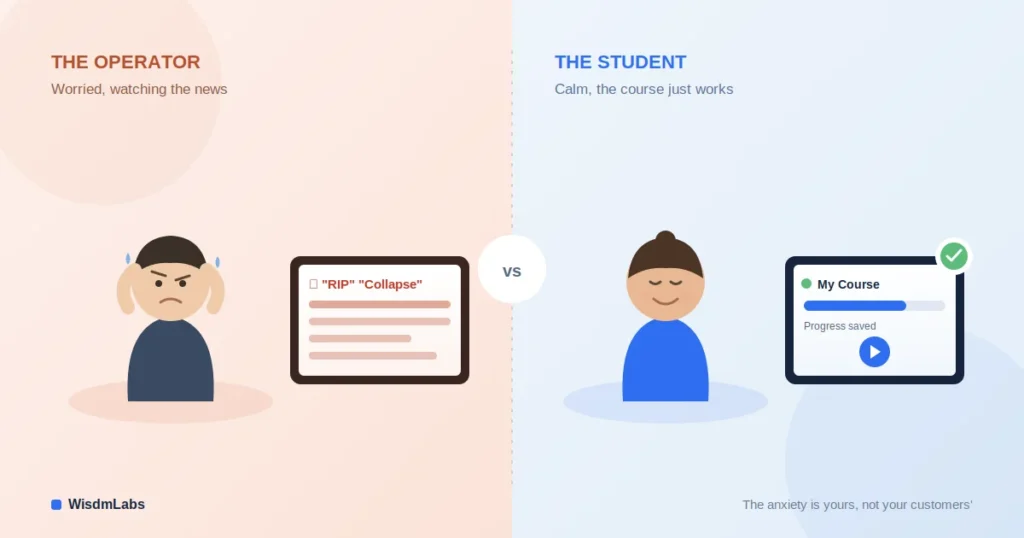
The anxiety is yours, not your customers’
The feeling pushing you toward an announcement is real, but it’s your feeling, not your customers’.
Operators are turning this over in private right now. We at WisdmLabs had a client with 3,400 students ping us about her renewal the week the news broke. The community reaction was loud, too: on Post Status Slack and WordPress Twitter, the framing ran to “RIP” and “collapse.”
Your customers, for the most part, saw none of that.
They logged in. Their courses loaded normally. Their progress was where they left it. From where they sit, nothing happened.
As one widely shared industry view put it, it’s far too early to declare this a failure or the death of these brands. Transmitting your private anxiety into their inbox doesn’t inform them. It just gives them a reason to worry that they didn’t have five minutes ago.
What your customers actually care about (and it isn’t the corporate news)
Your customers don’t care who owns the plugin. They care whether their stuff still works. Access to their courses. The price they pay. Whether the certificate they earned still means something. That’s the whole list for most of them.
Community research backs this up.
In a 2026 study that pulled 118 sourced complaints from creator forums and review sites, the single biggest pain point across every platform wasn’t outages or bugs. It was poor communication around them.
A LearnWorlds outage left multiple creators without access for days with no communication, and that silence-in-a-crisis is what people remembered, per the Ruzuku 2026 Course Platform Satisfaction Report.
Read that carefully, because it cuts both ways. Customers punish bad communication during a real disruption. They don’t reward unprompted communication about a disruption they never experienced.
The corporate restructuring behind LearnDash is not, to your customer, a disruption. It’s news about a company they’ve probably never heard of. The skill is telling those two situations apart.
The default is silence, and silence is not denial
Start from silence and make disclosure earn its way in. This is the opposite of what most advice tells you, and it’s the whole point of this playbook. Generic vendor-transition guides reflexively say “communicate proactively with your customers.” That advice is written by people with something to sell you on the move. Your situation is different: you’re trying to keep a working business calm.
Here’s the line that matters: Silence as a default means unprompted, not evasive.
You are not hiding anything. You are simply not manufacturing an announcement out of internal news. The moment a customer asks you a direct question, the silence ends and you give them a clean, honest answer.
A customer notification you send because you’re anxious is a different thing from a customer notification you send because someone asked, and only the second one is usually warranted.
When silence is the right call
If nothing in your customer’s actual experience has changed, you have nothing to announce. Your site runs. Logins work. Billing is unchanged. Their certificate is still valid. In that state, a proactive message is all cost and no benefit: it introduces doubt, invites questions you’d rather not field, and makes a non-event look like an event.
This holds whether you have 50 customers or 50,000. Scale changes the stakes of getting it wrong, not the underlying logic. A solo creator who over-explains looks jumpy. A large operator who over-explains generates a support queue out of thin air.
When a trigger earns disclosure
Three things turn silence into a reason to speak. Until one of them happens, you wait.
- A customer asks. Someone read a headline, or noticed learndash.com redirecting, and emailed you. That’s a real question and it deserves a real answer. (More on the inbound mode below.)
- A service change becomes visible to users. If you’re changing something your customers will see or feel, like a login flow, a checkout, or a feature they rely on, that visible change is the thing you communicate, not the corporate backstory behind it.
- A competitor forces it. A rival platform runs a “LearnDash is dead, switch to us” campaign and it reaches your audience. Now the conversation is happening with or without you, and a prepared response beats a panicked one.
Notice what’s missing from that list: “I feel uneasy.” Your unease is not a trigger.
Quick self-check: do you actually need to say anything?
- Has a customer asked you about it directly? (Y/N)
- Will your customers see or feel a change in how the product works? (Y/N)
- Is a competitor actively marketing to your audience about this? (Y/N)
- Are you changing your pricing, access, or terms as a result? (Y/N)
| How to evaluate: Four “no”s: stay quiet. You have nothing to announce. One or more “yes”: you’ve got a trigger. Match it to the right state explained below. |
The four communication states (and how each scales)
Your message depends on which state you’re in, and one playbook does not fit all four. Hold, Watch, Act, and the inbound “customer-asked-first” mode each call for different language, different scope, and different timing.
Each one also scales: what a solo creator does casually, a $1M+ operator does formally. Here’s each state, with the ladder built in.

Hold-quiet: you’re staying, so say nothing proactively
If you’ve decided to stay on LearnDash, your communication job is almost zero. Nothing about your customers’ experience is changing, so there’s nothing to announce.
If mapping your hold/watch/move decision to the comms call is the part you’re still working out, our 5-factor decision guide for LearnDash users covers the internal side; this piece picks up the external one.
The only thing worth doing in Hold is making sure your continuity claim is actually true.
If a customer ever asks, your honest answer is “everything’s running normally and we keep it that way,” which is only credible if you’re genuinely maintaining the site.
Quietly keeping updates, backups, and security current is what lets you stay quiet with a clear conscience. (If site upkeep isn’t something you’re set up to handle, ongoing WordPress maintenance is what makes the continuity promise real.)
- Solo creator: Do nothing. Keep running.
- Mid-tier operator: Do nothing proactively; brief whoever answers your support inbox so a stray question gets a calm reply.
- $1M+ operator: Do nothing proactively; make sure account managers and support have a one-line internal answer ready, so no one improvises.
Watch-prep: you’re preparing, so keep it internal
If you’re preparing to move but haven’t committed, that work stays behind the curtain.
Watch is the most dangerous state for premature disclosure. Telling customers “we might be switching platforms” creates all the anxiety of a move with none of the resolution. And if you then decide to stay, you’ve spooked people for nothing.
Keep your migration readiness work internal until it’s a decision, not a maybe. The 90-day migration readiness audit is a planning document for you, not a customer memo. The rule across every size: prepare loudly inside, stay quiet outside.
Act-in-flight: you’re moving, so communicate continuity, not drama
Once you’ve committed to a move, you do communicate, but you lead with continuity, not the backstory. This is the one state where a proactive customer notification is clearly right, because the change will touch your customers.
The community standard here is specific and modest: give people two to three weeks’ notice with clear access instructions, not a play-by-play of vendor drama.
What customers need to hear: what’s changing for them, when, and what (if anything) they need to do.
What they don’t need: the StellarWP wind-down history, your reasons for leaving, or any hint that things were precarious. “We’re upgrading the platform behind your courses; here’s your new login; nothing else changes” is the entire message for most audiences.
Handled well, a move actually reduces customer noise rather than creating it. When we at WisdmLabs ran a Xero-to-WooCommerce subscription migration for a course business, billing continuity held end to end and support queries dropped 40%, because customers never felt the seam. That’s the bar, a transition your customers experience as if nothing has happened!
If you’d rather not run that cutover alone, this is exactly the structured LearnDash transition support we run with course businesses of every size, where we coordinate the customer-facing message alongside the technical work so the two don’t fall out of sync.
- Solo creator: One warm, plain email. “Quick heads-up, I’m moving your courses to a better setup. Your login link is below. Same courses, same you.” Done.
- Mid-tier operator: A short notice email plus an updated FAQ or help-doc link, sent two to three weeks ahead, with a clear “what you need to do” line.
- $1M+ operator: Segmented notices by customer type (see below), account-manager outreach for high-value contracts, and a status page if you have one.
Customer-asked-first: the inbound mode
When a customer asks you directly, the silence strategy switches off instantly. You owe them a straight answer. This is where evasiveness would actually hurt you. The good news is that the honest answer is reassuring: the plugin works, the data’s intact, security patches are committed for now, and you’re on top of it.
Keep the answer short, factual, and calm. Resist the urge to over-explain. If they want the full context, point them to a neutral source rather than narrating it yourself. Our calm, fact-first briefing on what changed exists for exactly this.
If their question is about a specific add-on they rely on, the add-on inventory answers that without you having to.
How this scales is really about relationships, rather than size.
A solo creator who knows students by name can reply personally and casually. A $1M+ operator with a B2B contract holder needs a more formal, account-managed response.
The same words would feel false in the wrong direction: a corporate template from a solo creator reads cold, and a buddy-buddy note from a large vendor reads unprofessional.
Matching customer type, scale, and state to the right move
Use this table to find your row. It maps who you’re talking to against how big you are and which state you’re in, and gives you the move. Most readers only need one or two rows.
| Customer type | Business scale | State | Recommended approach |
| B2C subscribers / students | Solo creator | Hold / Watch | Say nothing. Keep running. |
| B2C subscribers / students | Solo creator | Act | One warm personal email: new login, “same courses,” 2–3 weeks ahead |
| B2C subscribers / students | Mid-tier / $1M+ | Hold / Watch | Say nothing proactively; brief support with a one-line answer |
| B2C subscribers / students | Mid-tier / $1M+ | Act | Segmented notice email + FAQ, continuity-led, 2–3 weeks ahead |
| B2B contract holders | $1M+ | Hold / Watch | Account manager keeps a ready answer; no proactive memo |
| B2B contract holders | $1M+ | Act | Direct account-manager outreach: roadmap, SLA, continuity commitments |
| Certification holders | Any size | Any state | Reassure on credential validity only; no platform backstory |
| Any type | Any size | Customer-asked-first | Clean, honest, short answer; point to a neutral source for detail |
| Any type | Any size | Competitor-forced | Send the prepared calm response (see below); don’t improvise |
Differentiating the message by customer type (if your business is large enough to need it)
If your business has distinct customer cohorts, the same email to all of them is the wrong email for each.
This section is for operators large enough to have these distinctions. If you’re a solo creator with one kind of customer, skip it; you’re not missing anything you need.
Your B2C subscribers care about service continuity: can I still log in, is my price changing, do my courses still work. Whereas your B2B contract holders care about commitments: SLA terms, roadmap, and whether the thing they signed for still holds.
And your certification holders care about one thing above all, which is whether the credential they earned (or are earning) still counts. Send all three the same generic notice and you’ve answered none of their real questions.
The practical move is to segment. Lead each message with the one concern that cohort actually has, and cut everything else.
A B2B contract holder doesn’t need reassurance about login screens; a student doesn’t need your roadmap. And if you’re making a customisation that genuinely changes the customer-facing experience, like a new login flow or a redesigned course player, that visible change is worth an explicit heads-up.
LearnDash customisation work that touches the learner’s experience should ship with a plain-language note about what they’ll see.
The competitor-exploitation risk every silent strategy has to plan for
The biggest threat to a silence strategy isn’t your customer noticing. It’s a competitor making them notice. A rival platform sees the LearnDash news as a sales opening and emails your audience: “LearnDash is dead. Migrate to us.” Now the conversation is happening, you didn’t start it, and if your reply sounds rattled, you’ve lost the room.
The fix is cheap insurance: keep one calm response drafted and ready before you ever need it. Not published, not sent, just written, so the day it’s needed you’re editing a measured message instead of composing one under pressure.
A prepared answer reads as confidence. A scrambled one reads as confirmation that the competitor was right. You’ll find a ready-to-send version in the templates below.

Ready-to-adapt message templates
Here are six templates covering the states and scales above. Adapt the voice to yours; the structure is the part that’s load-bearing. Keep them shorter than you think they need to be.
Template 1: Inbound reply, solo creator (customer asked, casual relationship)
Hi [Name], good question!
Short version: nothing’s changing for you. The software behind the courses had some corporate reshuffling in the news, but your access, your progress, and your login all work exactly the same. I keep a close eye on it.
If anything ever does change on your end, you’ll hear it from me first. Enjoy the course!
Template 2: Inbound reply, $1M+ operator (customer asked, formal)
Hi [Name], thanks for reaching out. We want to be clear: there is no change to your access, your pricing, or the way the platform works.
The recent news concerns the vendor’s corporate structure, not the product you use day to day, which continues to be fully supported and maintained on our end. If any customer-facing change is ever planned, we’ll notify you well in advance. Please reach out anytime with questions.
Template 3: Act-in-flight notice to B2C subscribers (access + continuity)
Subject: A quick upgrade to your course experience
Hi [Name], we’re moving your courses onto an improved platform over the next few weeks. Here’s what this means for you: your courses, progress, and certificates all carry over. On [date], please log in here instead: [link].
That’s the only change on your side. Same courses, same content, just a more reliable home for them. Questions? Just reply to this email.
Template 4: Act-in-flight notice to a B2B contract holder (roadmap + SLA)
Subject: Platform update and our commitments to you
Hi [Name], we’re writing ahead of a planned platform migration scheduled for [date range]. We want to confirm directly: all terms of our current agreement, including [SLA/uptime/support commitments], remain in force throughout and after the transition.
Your team’s access and data carry over with no interruption. We’ve scheduled a brief call on [date] to walk through anything specific to your account. Our goal is for this to be invisible to your users.
Template 5: Certification-holder reassurance (credential validity)
Hi [Name], because you’ve earned (or are working toward) a certification with us, we want to confirm one thing directly: your credential remains fully valid, and the records behind it are intact and preserved. Any changes to the platform are operational and do not affect the standing of certificates already issued or in progress. Nothing you’ve earned is at risk.
Template 6: Competitor-forced response (ready to send, calm, non-defensive)
Hi [Name], you may have seen messaging suggesting you need to switch platforms urgently. Here’s the straight picture: the product you use is stable, supported, and running normally. We evaluate our platform choices continuously and on the facts, not on anyone else’s marketing calendar.
If we ever decide a change benefits you, we’ll lead that conversation ourselves, with plenty of notice. For now, nothing needs to change, and nothing about your experience is at risk.
FAQ
Should I tell my customers about the LearnDash transition?
Usually not, unprompted. If nothing in your customers’ actual experience has changed, including access, pricing, features, and credentials, there’s nothing to announce, and a proactive message tends to create worry rather than remove it. Disclose when there’s a real trigger: a customer asks, a visible change is coming, or a competitor forces the topic.
How do I announce a platform change to my course customers?
Only announce when something is actually changing for them, and lead with continuity. Tell them what changes on their side, when, and what to do, typically two to three weeks ahead, with clear access instructions. Leave out the corporate backstory; it’s not what they need and it invites questions you’d rather not field.
When is it better to stay silent about a platform transition?
Silence is the right call whenever your customers’ experience is unchanged and no trigger has fired. Staying quiet here isn’t hiding; it’s declining to manufacture an event out of internal news. The moment a customer asks directly, you answer honestly. Until then, you have nothing to say, and saying it anyway has a cost.
What do I say if a customer asks me directly about the LearnDash transition?
Give a short, honest, calm answer: the product works, your data and access are intact, and you’re monitoring it. Resist over-explaining. If they want the full context, point them to a neutral factual source rather than narrating the drama yourself. That keeps your reply reassuring instead of alarming.
Will the LearnDash transition affect my course students?
For most students, no. Their courses, progress, and logins continue to work exactly as before, since the change is to the vendor’s corporate structure, not the product itself.
The main caveat is the longer-term roadmap, which is worth watching but isn’t something students experience today. If you want a fuller read on the product’s standing, our LearnDash 2026 review goes deeper.
If you’re weighing not just what to say but whether to move at all, that’s the harder half of the decision, and the customer-communication call and the technical call really shouldn’t be made in separate rooms.
We at WisdmLabs sit on both sides of this: we build on LearnDash and we help businesses move off it, which means we have no thumb on the scale either way.
If it’d help to talk through our LearnDash transition support process and how we coordinate customer communication with the technical work, that’s where we’d start: a 30-minute call, no pitch, for course businesses of every size. You bring the situation, and we’ll help you figure out what’s actually worth saying, and to whom.