

| Quick Time Capsule
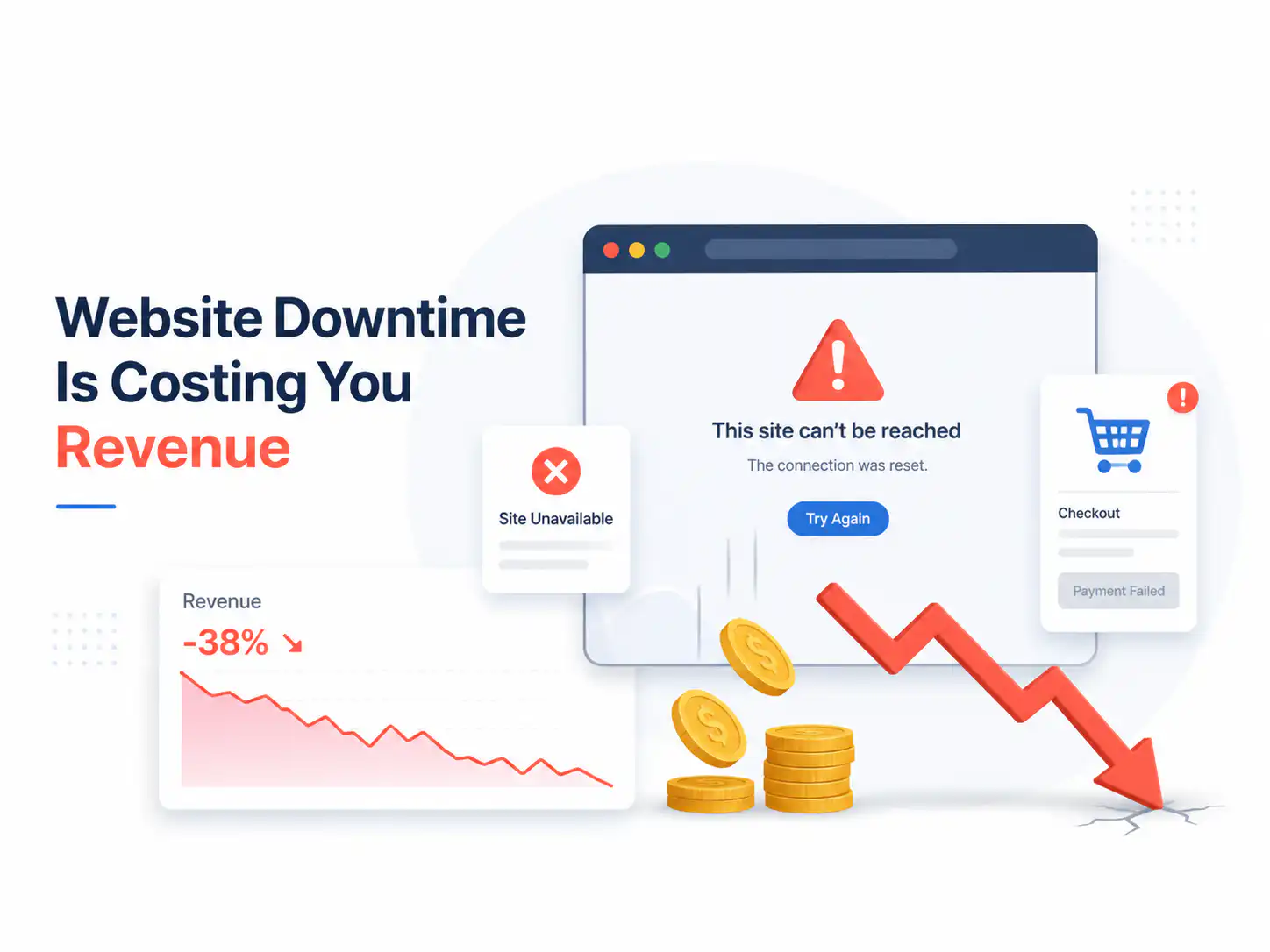
A few years ago, website downtime was seen as a temporary inconvenience. Today, it directly impacts revenue, customer trust, SEO rankings, and marketing performance. As websites have become more complex with integrations, plugins, and automation tools, even short outages can lead to missed sales and lost opportunities. That’s why website management services have evolved from optional technical help into an essential part of keeping modern businesses online, secure, and performing smoothly. |
It’s 4:47 pm on a Friday.
A plugin auto-updates, the WooCommerce checkout throws a 500 error, and for the next nine hours, nobody on your team knows which plugin caused it.
By Monday morning, your store is back. But roughly $4,200 in weekend orders never happened.
This is what “monthly revenue loss from downtime” actually looks like when you run a revenue site without dedicated technology support services.
We’ve walked into this exact scene with dozens of business clients over the past few years. The pattern is always the same: the outage itself is painful, but the bigger damage is the three-day scramble that follows.
Before we get into the costs and consequences, it helps to define what technology support services actually mean in a business context.

What Are Technology Support Services?
Technology support services refer to ongoing technical support that keeps your website and digital systems stable, secure, and performing as expected.
Instead of fixing issues only after something breaks, these services focus on continuous monitoring, regular updates, performance optimisation, and fast response when problems occur.
For most small and medium-sized businesses (SMBs), this means having a reliable support system in place that can:
- Detect issues early
- Prevent avoidable failures
- Resolve problems quickly when they impact users
The key difference is consistency.
Rather than relying on one-off fixes or ad-hoc help, technology support services provide a structured approach to maintaining and improving your digital infrastructure over time.
Once you understand what support looks like, the next question is simple: what happens when it’s missing—and how much does that actually cost?
How Much Does Website Downtime Cost?
According to the ITIC 2024 Hourly Cost of Downtime Report, even a micro Small and Medium-sized Business (SMB) with fewer than 25 employees and a single revenue-generating system can lose around $1,670 per minute (roughly $100,000 per hour) when you factor in lost orders, refunds, and recovery effort.
For a business running an e-commerce store, most industry estimates place downtime losses between $137 and $427 per minute.
A simpler way to calculate your own number:
- Take your monthly revenue
- Divide it by total operating hours
- Adjust for peak vs. off-peak traffic
For example:
A $40,000/month WooCommerce store running 24/7 averages about $55/hour. But if 60% of revenue comes from just 8 peak hours, that pushes peak-hour revenue closer to $180/hour.
That’s the number that actually matters during an outage.
The direct revenue loss is only part of the story. The bigger impact often comes from costs that don’t show up immediately.
Hidden Costs of Website Downtime Most Businesses Ignore
The direct hit is the smaller part of the total. The tail costs are worse:
● Abandoned carts that never return. A shopper who hits a broken checkout rarely comes back to finish the order later.
● SEO ranking damage from extended outages. Google crawlers that repeatedly hit 5xx errors reduce crawl frequency and, over weeks, rankings.
● Customer trust erosion. One WooCommerce store owner in a widely-discussed WordPress.org support thread noted that after the v8.5.1 update triggered 503 errors and maxed-out server CPU, the bigger loss was the three repeat customers who emailed asking, “Is your site legit?” before disappearing.
● Refund and support labour. Every broken order generates support tickets, chargebacks, and manual reconciliation, usually absorbed by a founder or ops person whose time has real opportunity cost.
Not all revenue loss comes from full outages. In many cases, the damage builds slowly through issues that never fully break the site.
How Bugs, Delays, and Slow Pages Cause Ongoing Revenue Loss
Full outages are easy to detect. Your monitoring system pings you, you see the error, you panic, and you fix it.
The bigger problem is what doesn’t trigger an alert.
The slower, quieter issues—the ones that don’t break the site completely—are often the ones that compound into consistent monthly revenue loss.
1. Slow pages are invisible downtime
A page that loads in 6 seconds isn’t technically “down.”
But from a revenue perspective, it might as well be.
Users don’t wait. They leave.
Google’s research on mobile page speed shows that even a one-second increase in load time can lead to:
- A 7% drop in conversions
- A 20% drop in ad revenue for publishers
For a small e-commerce business, that kind of drop often exceeds the financial impact of a single outage.
What makes this worse is that slow performance rarely triggers alarms. The site loads. Monitoring tools stay quiet. But conversions steadily decline.
We’ve seen this firsthand. During a speed optimization engagement with Ofenakademie, mobile PageSpeed improved by 32.5%. The revenue impact became visible within a month—not because anything was broken before, but because the site had been underperforming quietly for nearly two quarters.
2. Post-update bugs: the silent checkout killer
This is where many sites lose revenue without realising it.
An update rolls out overnight:
- WordPress core updates
- A plugin auto-updates
- A theme patch is applied
On the surface, everything looks fine:
- Homepage loads
- Blog works
- Navigation is intact
But something deeper in the flow breaks.
For example, a subscription renewal endpoint might start throwing a silent 500 error on a percentage of transactions. Not enough to crash the site—but enough to steadily eat into revenue.
These issues are rarely caught immediately because they don’t affect the entire site—only specific user journeys.
The pattern shows up repeatedly in community reports. In one WordPress.org thread covering the 6.9.1 + BackWPup + AIOSEO critical error, multiple site owners described being locked out of wp-admin after an update combination they hadn’t explicitly triggered.
In another case involving a plugin update v6.2.3 that broke production sites includes owners reporting “site is down, customers calling, nobody knows why”, with the common thread being that nobody had a pre-arranged technology support services relationship to call.
The common thread isn’t the bug itself.
It’s the absence of a pre-arranged technology support services setup to respond quickly.
3. Plugin conflicts that nobody owns
A typical WooCommerce site runs anywhere between 30 to 60 active plugins.
Each plugin:
- Is built by a different developer
- Follows a different update cycle
- Is tested against different environments
Conflicts aren’t rare. They’re inevitable.
In fact, plugin incompatibility consistently ranks among the top causes of downtime.
But the more important question isn’t:
“What broke?”
It’s:
“Who owns fixing it?”
In most freelance or ad-hoc setups, the answer is: no one.
Each issue is handled as a one-off task. Fixes are reactive. There’s no continuity, no shared context, and no accumulation of knowledge about your specific stack.
Over time, this lack of ownership turns small, isolated issues into recurring revenue leaks.
When these issues keep repeating, the problem usually isn’t technical—it’s structural. The way support is set up determines how problems are handled.
Why Ad-Hoc Technology Support Services Fail Businesses

The root cause of most small-business revenue loss due to site issues isn’t technology.
It’s the gap in the operating model that sits underneath the technology.
When support is reactive, fragmented, and loosely defined, even small issues are allowed to grow into larger, more expensive problems.
1. The “who do I call” problem on Friday at 4:47pm
If your relationship with development help is “email the freelancer who built the site two years ago”, you are one unanswered email away from a 48-hour outage.
Most independent developers aren’t on-call for clients they last invoiced in 2024. This isn’t a character flaw. It’s the structural reality of project-based work.
In the absence of immediate help, businesses are forced into guesswork.
Basic triage can help in some cases. Tools like the WisdmLabs WordPress Bug Fixing Chatbot can walk a non-technical owner through initial checks as:
- Plugin deactivation
- Cache clearing
- Backup restoration
In many cases, this resolves up to 30% of common issues without developer involvement.
But when those steps fail—and they often do—you need someone who already understands your site’s structure, dependencies, and history.
Without that, every incident starts from zero.
2. Hourly billing punishes you for reporting small issues
At first glance, hourly support seems flexible and cost-effective.
In practice, it creates a dangerous incentive to delay reporting small issues.
A broken form.
A checkout button is not working on Safari.
An email notification that quietly stopped sending.
Each of these feels too minor to justify a $100–$150 minimum call-out.
So the issue sits.
And while it sits, it compounds.
By the time it’s addressed, it’s no longer a small fix—it’s part of a larger failure. What could have been a quick 20-minute resolution turns into a multi-hour emergency debugging session costing thousands.
Capterra reviews of WordPress highlight this exact tension. The consolidated review thread for WordPress on Capterra repeatedly surfaces the discovery that there’s no “white-glove” support built in, which becomes a real problem the first time something critical breaks and the community forum is the only fallback.
Our deep-dive comparison of hourly billing versus a WordPress development retainer shows the same dynamic in the data: retainer clients report issues earlier and resolve them more cheaply.
3. Why Lack of Ownership Leads to Recurring Problems
The deeper issue isn’t response time. It’s ownership.
In ad-hoc setups:
- Every issue is treated as a separate task
- No one maintains long-term context
- Fixes are reactive, not cumulative
There’s no system to track:
- What broke previously
- Which plugins conflict
- What custom logic exists in your setup
So the same categories of issues repeat—just in slightly different forms.
Over time, this creates a cycle:
Fix → forget → repeat
Our internal comparison between hourly support and a technology support retainer shows a consistent trend: Retainer clients report issues earlier, resolve them faster, and experience fewer repeat incidents.
Because someone owns the system—not just the task.
This is where a structured support model changes the equation—from reactive fixes to consistent, ongoing stability.
What a Technology support retainer actually covers
A real retainer is a named team with context on your specific site, a response-time commitment, and a mix of proactive and reactive work sized to your actual stack.
A legitimate plan covers the items below:
1. Proactive work that prevents most incidents
● Scheduled core, plugin, and theme updates applied on a staging environment first. Not auto-applied on production.
● Weekly off-site backups with tested restoration. The difference between “we have backups” and “we have backups that work” is often discovered during a real incident.
● Security monitoring and vulnerability patching, including scanning for abandoned plugins in your stack.
● Uptime monitoring with a real pager, not just an email that might get filtered.
● Performance monitoring that catches the slow-page creep before it hits conversions.
Our WordPress Maintenance – Ultimate Guide (2025) covers each of these in depth.
Even with prevention, some issues are unavoidable. What matters then is how quickly they’re identified and resolved.
2. Reactive work that shortens the ones you can’t prevent
Prevention gets you maybe 70% of the way. The other 30% is incident response. What matters here is the mean time to recovery (MTTR): how fast the team can identify, fix, and verify after something goes wrong.
A retainer team with pre-existing context on your site typically resolves incidents in 2 to 6 hours. An ad-hoc freelancer engagement averages 12 to 36 hours in our experience, mostly lost to context rebuilding.
| Is your site a retainer candidate? Quick self-check
Run through these six questions. If you answer “yes” to four or more, you’re past the break-even line: 1. Does your site directly generate revenue (e-commerce, subscriptions, lead gen)? 2. Do you run more than 15 active plugins? 3. Have you experienced at least one unplanned outage in the past 12 months? 4. Is your current dev support “email the person who built it”? 5. Would four hours of downtime during business hours cost you more than $500?6. Have you lost at least one customer or transaction to a site bug this year? When a retainer is the wrong choice If your site is a low-traffic brochure site with no transactional layer, a retainer is overkill. Managed hosting plus quarterly updates handled by a freelancer is fine. We tell prospects this regularly. A retainer earns its cost on revenue-critical infrastructure, not on every WordPress site that exists. |
If you do decide to move forward, choosing the right provider makes all the difference in long-term results.
Conclusion
Website issues rarely fail loudly—they fail quietly, through missed orders, slow pages, and bugs that go unnoticed for weeks.
By the time the problem becomes visible, the revenue loss has already happened.
That’s what makes technology support services less of a technical expense and more of a business safeguard. When your site is directly tied to revenue, relying on ad-hoc fixes or delayed responses isn’t just inefficient—it’s expensive.
A structured support model ensures problems are prevented where possible and resolved quickly when they’re not.
If your website plays a critical role in how your business operates, it needs more than occasional attention. It needs consistent, accountable support.
Frequently asked questions
What are technology support services for a website?
Technology support services are ongoing technical services that keep your website stable, secure, and functional. They include updates, bug fixes, monitoring, and quick issue resolution—unlike one-time fixes.
How much do technology support services cost for a WordPress site?
Most WordPress support retainers cost between $200 and $800 per month, depending on site complexity and support needs. Plans under $100/month are usually automated, not full support.
Is a technology support retainer worth it?
Yes, if your site generates revenue. A retainer reduces downtime, fixes issues faster, and prevents hidden problems like slow pages or broken checkouts from affecting conversions.
What’s the difference between website maintenance and technology support services?
Website maintenance covers routine tasks like updates and backups. Technology support services go further by handling real-time issues, debugging, and ongoing performance improvements.
What does a WordPress support retainer include?
A support retainer typically includes updates, backups, monitoring, bug fixes, performance checks, and access to a team that can respond quickly when something breaks.
How fast should a support provider respond to issues?
For revenue sites, response should be within 30–60 minutes, with most issues resolved within a few hours. Delays beyond that can directly impact revenue.