

| QUICK ANSWER
Managing freelancers becomes a bottleneck when the founder holds the context no individual freelancer has: the briefing, the review, the handoffs between people, and the fix when something breaks. For a business whose website drives revenue, that coordination work grows faster than the freelance capacity you add. The signal to change the model is not cost per task. It is how many hours a week the founder now spends keeping the setup moving. |
You outsourced the development work because your business has reached the point where you should not be spending your week inside website tickets.
Maybe you’re running a $1M+ eCommerce brand on WooCommerce, an eLearning business with hundreds or thousands of active learners, or a membership business where the website now sits directly in the path from acquisition to payment to customer access.
So the week should have gotten lighter.
Instead, you spent Tuesday writing a brief for a checkout change, Wednesday explaining the same store architecture to a second freelancer, and Thursday testing whether the change had broken an existing subscription flow.
Nobody did anything wrong. The freelancer completed the task you gave them.
The problem is that you were still the person holding everything around the task: why the change was needed, what else it could affect, which integrations matter, what was changed last month, and whether the site is safe to push live.
That distinction becomes harder to ignore as a scaling business grows.
At $1M+ in annual revenue, your WordPress site is rarely just a website anymore. For an eCommerce brand, it may handle checkout, subscriptions, payments, inventory and customer accounts. For an eLearning or EdTech business, it may connect enrollment, courses, memberships, payments and CRM workflows. For a membership business, access rules and recurring billing can make a seemingly small change business-critical.
You can outsource the execution of those changes. But if every decision, handoff, review and escalation still comes back to you, you have not outsourced ownership.
That’s when managing freelancers stops being a way to free up your time and starts becoming another job you have to run.

.
The Work You Still Have to Manage
You became the project manager by default, because someone had to be. Freelancers are hired to execute scoped work. Prioritizing, sequencing, and deciding what happens next were never in anyone’s scope, so they stayed with the person who owns the business.
The cost of that is measurable.
A store with live subscriptions, a course library with enrollment paths, a member area with tiered access: each of those needs someone who understands how the pieces connect. If that person is you, you are the integration layer.

Also Read: Hire a WordPress Developer: Freelancer, Agency, or Retainer?
| Hiring freelancers takes tasks off your plate, but it doesn’t automatically take the management of those tasks with them. The decisions about what happens next, who needs what context, and how the work fits together still need an owner, and for many founders, that owner is still them.
With one freelancer, that coordination is usually a few messages a week. Add a second and a third, and you are suddenly managing dependencies between people who have never met each other and share no context except what you provide. So, think about it: does the extra help actually reduce your workload, or does it overburden you with coordination overhead? |
Still the person managing every website change?
If your WordPress site has become too complex to manage through scattered freelancers, see how dedicated website management can take coordination, maintenance, and ongoing development off your plate.

Adding another freelancer adds a handoff, not capacity
Hiring another freelancer increases how much work can be done and increases how much coordination you personally absorb. Every additional freelancer creates another stream of context, decisions, reviews, and potential dependencies for someone to coordinate.
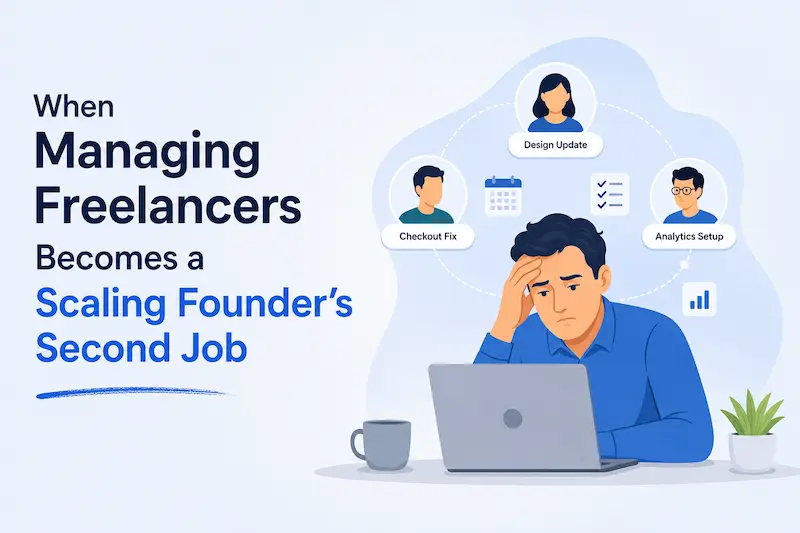
Consider a scaling WooCommerce business preparing for a major campaign. The designer is updating the landing page, one developer is changing the checkout flow, and another freelancer is handling analytics and tracking. Each person has a clearly defined task. The problem starts at the points where those tasks intersect.
Someone still has to make sure the new design reaches development on time, the checkout changes do not interfere with existing subscription or payment flows, and conversion tracking is working before paid traffic starts.
For a scaling eLearning business, the equivalent might be a major course or cohort launch. One freelancer is updating LearnDash enrolment logic, another is working on a payment integration, and a third is adjusting the course drip schedule. Again, each task is scoped. But a change to enrolment logic could interfere with the payment trigger, or a drip schedule could release content to learners who have not completed payment.
The coordination problem is the same in both businesses. The stakes are different. For the WooCommerce store, a miscommunication can disrupt checkout, subscriptions, or attribution during a revenue-generating campaign. For the eLearning business, it could lock paying learners out of content they just enrolled for.
And the person expected to catch those dependencies, resolve the conflicts, and make the final call is usually the person who holds the context across all three projects.
That’s most likely you.
| Setup | What you gain | What you now own |
| 1 freelancer | Execution on scoped tasks | One brief, one review cycle, one relationship |
| 3 freelancers | Parallel work across design, development, fixes | Three briefs, handoffs between them, conflicting changes, three review cycles |
| 5 or more | Real capacity, on paper | Sequencing, dependency tracking, context transfer, and every escalation |
What changes between one freelancer and three
The shift from one freelancer to three is about dependency, rather than volume. The developer needs the designer’s file. The designer needs your decision. The person fixing the bug needs to know what the other two changed last week. And you are the only one who knows all three.
What changes at five and above
Above five, the coordination stops fitting into the edges of your day. You are the only person who knows the whole site, so every question routes to you, and each one arrives as an interruption rather than a scheduled task.
This Medium article cites research by Gloria Mark at the University of California, Irvine, which found that interrupted work can take an average of 23 minutes and 15 seconds to resume.

Reviewing work you cannot technically review is the hidden tax
Reviewing freelance technical work is the part founders carry silently, because it cannot be delegated to the person who did it. You are the last check before something reaches customers, and you are checking work in a discipline that is not yours.
And the risk is not only quality. Sometimes the freelancer quits partway and leaves the work half-finished. And it all falls back to you.
Take a subscription business with hundreds of active customers. A freelancer updates the checkout to support a new offer. The page looks right and a test purchase works, but what about existing renewals, failed-payment retries, account access, confirmation emails and analytics? The founder can verify what they see on screen. What they cannot easily verify is everything the change might have affected behind it.
| So the hidden cost is not just the time spent managing freelancers. It is also the responsibility that stays with you after the work has been delegated — reviewing it, making the final call, and dealing with what happens when a project does not go as planned.
That does not make freelancers the wrong model. The more useful question is what kind of work the model is actually built to handle, and where the website starts needing something beyond task-by-task execution. |
Related Read: How to Pick a WooCommerce Developer (and why it should be a WooExpert)
Freelancers scale for scoped work and stall on continuous ownership
Freelancers work well when the work has edges. A defined build, a specific integration, a plugin customization, a redesign of one template: give a good freelancer a bounded problem and you will usually get a good result.
The model starts to strain when the work no longer has those edges. When one change depends on another, priorities keep shifting, and decisions need context from work completed months ago, the website needs more than someone available to execute the next task.
It needs someone holding that context between tasks and projects.
Imagine a elearning business where the website now has a backlog of 15 requests: improve checkout conversion, launch a new pricing page, fix an integration, improve Core Web Vitals, add a CRM workflow, update analytics, and prepare for next month’s campaign.
Finding freelancers capable of doing those tasks may not be difficult. Deciding what should happen first, what depends on what, and what can safely wait is the harder job. If every one of those decisions still comes back to the founder, the business hasn’t really delegated ownership of the website.

Where the work is genuinely bounded and technical, hiring WordPress developers on retainer gives you consistent capacity without you writing every brief.
Where the complexity is store-specific, with multiple integrations and custom purchase logic, that is a WooCommerce development problem rather than a coordination one.
So the question becomes which model your website actually needs right now.
Which model fits your website right now
Three models are legitimate, and the right one depends on how much continuous ownership your site needs rather than on your budget.
When individual freelancers are still the right choice
Freelancers remain the right call when the work is project-shaped and infrequent. You need a landing page built, a plugin conflict resolved, a one-off migration handled. There is a clear start and finish, the work does not depend on other work happening in parallel, and nothing needs to be remembered six months later.
Keep this model if you spend a few hours a month coordinating, not a few hours a week.
When dedicated development capacity is the right choice
Dedicated capacity fits when the work is continuous but the direction is clear. You know what needs building for the next two quarters, you have a roadmap, and what you lack is reliable hands who already understand your setup.
This is the middle path, and it removes the re-briefing tax without changing who sets priorities. If you are weighing it against the alternatives, how to hire a WordPress developer the right way covers what to look for.
When website management is the right choice
Website management fits when the problem is ownership, not capacity. The site is revenue-critical, requests arrive faster than you can triage them, and you are the only person holding the whole picture.
| Three models, and each one is correct for a different situation. Which one is yours depends on something you have probably never counted: the hours you personally spend each week briefing, chasing, reviewing and patching. The check below counts them for you, and your answers will point back at whichever of the three sections above described your week. |
Need more than another freelancer?
Whether you need dedicated WordPress development capacity or someone to take ongoing ownership of your website, find the model that fits your current stage of growth.
How much of your week is freelancer management? A 6-question check

Answer yes or no. Count the yeses.
1. In the last month, did you explain the same background to more than one freelancer? (Y/N)
2. Have you tested or reviewed work you were not technically equipped to judge? (Y/N)
3. Has a change by one freelancer created a problem another had to fix? (Y/N)
4. Are you the person everyone messages when the site breaks? (Y/N)
5. Has a launch or release waited on a clarification only you could give? (Y/N)
6. If you stepped away for two weeks, would website work stop? (Y/N)
0 to 1 yes. The model is working. Freelancers are doing scoped work and you are not carrying the coordination. Keep it this way, and revisit as the site grows.
2 to 3 yes. The coordination load is real but contained. Worth naming a technical owner for the site before the pattern compounds. Dedicated development capacity usually fits here.
4 to 6 yes. You are the operating layer for your website rather than the person making business decisions about it. That is a structural gap, and a common one. Explore Website Management Services →
Conclusion
You outsourced the execution, and the ownership stayed with you.
As the website carries more of the business, that ownership gets heavier rather than lighter, because there are more dependencies to hold in one head and less room in the week to hold them.
So step back and count honestly. How many hours went to briefing and re-briefing last month? How often were you the only person who could answer a question? What waited on you? Use the six-question check above rather than a gut feel.
If most of your answers were no, individual freelancers are serving you well and nothing needs changing. If the work is continuous but you know where it is going, dedicated development capacity closes the gap.
If you are the person everyone routes through and the site cannot move without you, the gap is ownership, and no amount of extra hands will close it.
Start by counting one week honestly: every brief, every follow-up, every review, every fix.
If that count is now a meaningful part of your week, manage your website with WisdmLabs →
FAQ
Is it cheaper to manage freelancers or use a website management service?
Per task, freelancers are almost always cheaper. Per month, the comparison changes once you price your own coordination time at what your hours are worth. If you spend six hours a week briefing, reviewing and chasing, that is roughly three working days a month that never reach the P&L as a website cost, but it is a cost.
What should a freelancer own and what should stay in-house?
Give freelancers work with clear edges: a defined build, a specific fix, a one-off migration. Keep in-house anything that requires standing context or prioritization, or delegate it to a partner who takes on that ownership explicitly. The failure mode is handing out execution while assuming responsibility travelled with it.
What happens to my website if a freelancer disappears mid-project?
You inherit a half-finished change and no documentation, a risk one merchant on Practical Ecommerce described as a project getting “dumped” on flat-rate terms. Reduce the exposure by requiring staging access, handover notes and repository access before work starts. Our guide on choosing a WordPress development company covers what else to check.