


| QUICK ANSWER
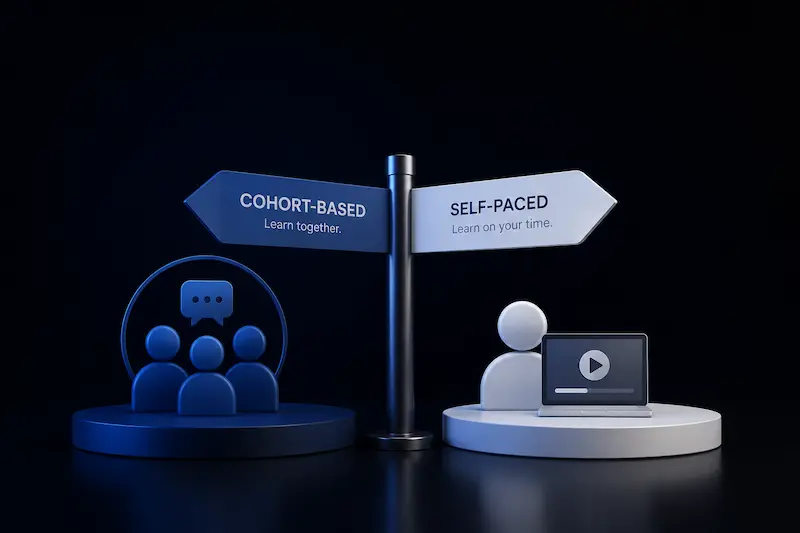
Cohort based courses move a fixed group of learners through content on a shared schedule, while self-paced courses release content based on enrollment date or learner progress. The difference is not only pedagogical: cohorts require scheduled access, group enrollment, instructor workflows, and time-bound reporting, while self-paced courses require progression rules, prerequisites, and heavier automation. For an established edtech business, the model chosen at build time determines which future changes are cheap and which require rebuilding. |
A course business we spoke with had 4,000 learners across eleven self-paced programs and a plan to launch its first instructor-led track in the spring. The content was ready in a fortnight.The platform took four months.
Running a cohort meant scheduled access, and scheduled access meant duplicating courses that thousands of learners already had progress in.
That is the part established course businesses often discover late: adding a new way to sell or deliver learning can look like a product decision from the outside and become an architecture project underneath.
That is why choosing between cohort-based and self-paced learning is not simply a decision about how learners consume a course.
Each model creates different requirements for enrolment, access, scheduling, learner progress, instructor involvement, and the systems around them. Those differences are relatively easy to account for when they are planned from the start.
They become much harder to retrofit once thousands of learners and years of course data depend on the original setup.
Cohort-based or self-paced?

The delivery model you choose becomes the operational model you run and the platform you maintain. Cohorts are a scheduling commitment. Self-paced is an automation commitment. Both are permanent in a way the content is not.
Ruzuku’s analysis of more than 32,000 courses on its platform found cohort-based courses complete at 53.4% against 41.9% for self-paced, with large-marketplace MOOCs at roughly 12.6%.
The same data puts cohort pricing at two to five times self-paced, and cohort discussion volume at 311 comments per course against 83.
So cohorts complete better and earn more per learner. They also cost more to run, and the cost is not mostly instructor time. It is everything the platform has to do to make a schedule work.
Here is the chain worth keeping in mind for the rest of this article: business model shapes learner experience, which shapes operational workflow, which shapes platform architecture, which determines what it costs to change your mind.
Every “we’ll fix it later” is a payment you deferred, not avoided
Deferring a platform capability does not remove its cost; it moves the cost to a point where learners, payments, and course history are already attached to the old structure. Every sentence below sounds like a scheduling decision and behaves like an architecture decision.
“We’ll add scheduled access later”
Scheduled access changes more than when a learner enters a course; it changes how courses, groups, and learner progress are structured.
Add it after thousands of learners are enrolled, and you may end up duplicating courses and splitting progress and completion history.
“We’ll automate learner communication later”
Cohort communication runs on dates, groups, and milestones rather than individual learner actions.
Adding it later means building scheduling logic around a platform that was originally designed for self-paced communication.
“We’ll introduce cohorts later”
Cohort enrollment is a different operation from individual enrollment, and platforms rarely treat them as the same thing.
Consider a self-paced training business that wins a corporate client wanting to enroll 200 employees into the same eight-week program. To the sales team, that is one new account. To the platform, it introduces group enrollment, fixed access dates, manager-level reporting, instructor scope, and potentially seat transfers when employees change.
For a high-growth elearning business, a corporate contract like this could be worth $40,000–$150,000 annually. If the platform cannot support group enrollment cleanly when the opportunity comes up, the consequence is not simply a technical limitation. The business may lose the contract altogether—or deliver a broken experience during a high-value client’s first interaction with the platform. At that point, a platform gap has become a revenue problem.
Related Read: LearnDash Groups: everything you need to know
“We’ll connect payments later”
Payment logic follows access logic, so changing one usually means reopening the other. A self-paced subscription grants ongoing access. A cohort seat grants time-bound access to one instance.
If you later sell both, you need entitlement to survive a learner holding a subscription and a cohort seat at once, with different expiry rules.
“We’ll add instructor workflows later”
Giving instructors access to a cohort changes the platform’s permission model, not just the interface.
They need to see, manage, grade, and communicate with their learners without gaining access to everyone else.
“We’ll build reporting later”
Cohorts introduce new reporting dimensions: group, dates, transfers, completion, and sometimes duplicated course structures.
If those relationships weren’t designed into the data model, reporting becomes reconstruction rather than retrieval.
| So far: you have six sentences that sound like scheduling decisions but behave like architecture decisions. The build cost for any of these is not the expensive part. What makes them expensive is that by the time you add them, thousands of learners may already have progress, payment history, and certificates tied to the current structure, which of those six is on your roadmap? . |
Is your current LMS built for the way you plan to sell next?
If adding cohorts, group enrollment, or new access rules would mean duplicating courses or rebuilding learner workflows, it may be time to rethink the underlying structure.

What cohort-based courses require from the platform
Cohort-based courses require the platform to understand time and groups as first-class concepts, which most course setups do not do by default. Everything below is a capability, not a setting.

• Group enrollment, including bulk adds, seat limits and transfers between cohorts
• Access windows, where content opens and closes on dates rather than on progress
• Schedules per instance, so the spring cohort and the autumn cohort are the same course on different calendars
• Instructor scope, so a group leader sees their learners and nobody else’s
• Group communication, tied to the cohort rather than to the course
• Assessment cycles with submission deadlines, review queues, and feedback windows
• Attendance and progress reported per cohort, and still meaningful after the cohort ends
These requirements also need to hold up after the cohort ends. Attendance, progress, submissions, and completion records should remain tied to the learner rather than disappearing with the cohort.
Some of these requirements have relatively straightforward solutions. Where enrollment volume is the constraint rather than scheduling, group registration codes solve a narrower version of this well.
What self-paced learning simplifies, and what it doesn’t
Self-paced learning removes scheduling and instructor coordination, and it does not make the platform simpler. It relocates the complexity from operations into software.
What genuinely gets easier: no calendars, no cohort seats, no instructor rotas, no timezone handling, no cost that scales with facilitator hours.
What gets harder as the catalogue grows: prerequisites and content-release rules, personalised pathways, subscription and renewal logic, automated assessment, certification rules, and learner journeys that behave sensibly across eleven programs rather than one.
A mature self-paced platform is usually more software than a mature cohort platform. It just needs fewer people on a Tuesday morning.
Also Read: LearnDash customization tools for advanced LMS workflows
| Neither model is the simple one; they are simple in different places. A cohort costs you scheduling and instructor coordination; self-paced costs you personalization, prerequisites, and subscription logic across every program you run. What comes next is the version most established course businesses actually end up in, which is both at once, and the part of the bill nobody budgets for. |
Where hybrid models change the architecture
Imagine an established course business built around a self-paced subscription library. Thousands of learners can join at any time, work through programs independently, and renew without anyone managing their schedule.
The business now wants to introduce a six-week instructor-led cohort as a premium upsell for its most engaged learners.
On the pricing page, that looks like another product tier. Inside the platform, it creates an entirely new set of rules. A learner may now hold an active subscription and a cohort seat at the same time, with different access periods, communication, instructor involvement, and reporting requirements.
Hybrid models change the architecture by forcing four things to be built once instead of twice: identity, entitlement, progress, and reporting. Sell both formats and a learner is one person who might hold a subscription, a cohort seat, and progress that has to survive moving between them.

| Capability | Cohort-based | Self-paced | Hybrid |
| Access control | Calendar dates per cohort | Enrollment date or progress | Both, resolved per entitlement |
| Enrollment | Group, with seats and transfers | Individual | Group and individual against one learner record |
| Instructor role | Required, scoped to a group | Optional or absent | Scoped, and only on cohort programs |
| Communication trigger | Schedule | Learner action | Both, without duplicate sends |
| Payments | Time-bound seat | Subscription or one-off | Concurrent, with different expiry rules |
| Reporting unit | The cohort | The learner | The learner, across formats and history |
Read the right-hand column as a build estimate. Every row that says “both” is a decision someone has to make deliberately rather than inherit.
Planning to run cohort and self-paced programs on the same platform?
Before adding another course type, map how access, payments, progress, permissions, and reporting will work across both.
Design for the model you have and the model you’re likely to add
Build for the model you run today, and keep open only the decisions that are expensive to reverse. That is a much smaller list than “build everything,” and it is the difference between flexibility and overengineering.
Decide access and entitlement separately from content
Access rules and course content should not be the same object, because that coupling is what forces course cloning later. If a course is a body of material and entitlement is a separate record saying who can see it, when and for how long, adding a cohort is a new entitlement rule rather than a duplicate course.
This is the single highest-value decision on the list, and it costs almost nothing on day one.
Automate the repetitive layer, not the decision layer
Automate the work that repeats identically every cohort and leave the judgment calls alone. Reminders, enrollment confirmations, progress nudges, deadline warnings, certificate issuance,, and first-line support triage all repeat. Whether a learner gets an extension does not.
AI is genuinely useful on the first list, particularly for support triage and learner communication where volume grows with every cohort you run. It is a poor fit for the second, and treating it as one creates work rather than removing it. If you are mapping where automation fits your workflows, our Chatbot Consultant is a reasonable starting point.
When building cohort-first is the right choi.ce
Cohort-first is right when your pricing, positioning, and outcomes depend on the cohort. High-ticket programs, professional certification, anything where the group is part of what people are buying.
Accept the scheduling and instructor architecture upfront. Adding self-paced later is comparatively cheap, because a self-paced course is a cohort of one with no calendar.
When building self-paced-first is the right choice
Self-paced-first is right when volume is the model and margin depends on not adding facilitator hours per learner. Broad catalogues, subscription libraries, top-of-funnel content.
Build it self-paced, and separate entitlement from content anyway. That one decision is what keeps a future cohort from becoming a four-month project.
When building for both from the start is the right choice
Build for both when a second format is already on the roadmap with a date attached, or when you are replatforming anyway. Those are the only two situations where the extra cost is justified rather than speculative.
Outside them, building for both is a bet on a product decision you have not made yet. If you are weighing whether your current platform can carry either path, our founder’s guide to LearnDash alternatives works through the same question from the platform side.
| Three build orders, and the wrong one does not fail loudly; it just makes your next launch cost four months instead of four weeks. Which one fits depends on how confident you are about the programs you will be selling in two years. The check below sorts your decisions into the reversible ones and the ones worth getting right now. |
| Which decisions are expensive to change later? A 6-question check
Answer yes or no. Count the yeses. 1. Do learners already have progress and payment history tied to your current course structure? (Y/N) 2. Would you struggle to say whether access is controlled by enrollment date, calendar date, or learner progress? (Y/N) 3. Would launching an instructor-led version require duplicating existing courses? (Y/N) 4. Do instructors need permissions your platform does not currently grant? (Y/N) 5. Does reporting break or get manual when a learner moves between programs? (Y/N) 6. Is there a delivery format on your roadmap your platform has never run? (Y/N) 0 to 1: yes. Your architecture matches your model. Build the next program the way you built the last one and revisit when the roadmap changes. 2 to 3: yes. Specific workflows are already being handled manually. Worth fixing those before the next launch rather than after it, while the change is still small. 4 to 6 yes. The platform is shaping your product decisions rather than serving them, and each new format will cost more than the last. |
Choose the course model before the platform chooses it for you
Cohort based courses and self-paced courses are not two ways to package content. They are two sets of requirements for how your platform handles access, learners, instructors, payments and automation.
As the catalogue grows, those requirements stop being adjustable. Learners accumulate progress, payments accumulate history, and every workaround your team invented becomes something the next change has to accommodate.
So look at the decisions rather than the features. Which of your access rules are tied to content that would need duplicating? Where is a person doing something a schedule should do? What would it actually take to run one cohort next quarter? Use the six-question check above rather than a general sense of flexibility.
If your answers pointed at a structure that fits your model, keep building the way you are. If particular workflows have become manual without anyone deciding they should, fix those before the next launch. If the platform cannot run a format that is already on your roadmap, that is an architecture decision waiting rather than a feature request.
Start by writing down the one delivery format on your roadmap your platform has never run, then ask what it would take to run it next quarter.
If that answer involves duplicating courses your learners are already enrolled in, plan your LearnDash platform with WisdmLabs →
FAQ
What is the difference between cohort-based courses and self-paced courses?
Cohort-based courses move a fixed group through content on a shared schedule with an instructor, while self-paced courses let each learner progress independently from the moment they enroll. The operational difference is larger than the learner-facing one: cohorts need calendars, groups, and instructor permissions, while self-paced needs progression rules and automation.
Can I add cohorts to an existing self-paced course platform?
Yes, but it is rarely a settings change. LearnDash ties cohort scheduling to group start and end dates, and its documentation states that a course using those dates cannot belong to multiple groups. The standard workaround is cloning the course per cohort, and with learners already enrolled, that split affects progress, reporting, and certificates.
Do cohort-based courses have better completion rates?
On the available data, yes. Ruzuku’s analysis of over 32,000 courses found 53.4% completion for cohort-based courses against 41.9% for self-paced, with marketplace MOOCs near 12.6%. Cohorts of 11 to 25 learners performed best at 65.2%, which suggests the gain comes from group accountability rather than from scheduling alone.
Is a hybrid model worth the extra complexity?
It is worth it when a second format is already on your roadmap with a date attached, or when you are replatforming anyway. Outside those cases, the cheaper move is to build the model you sell today while keeping access and entitlement separate from course content, which is the decision that makes a future format affordable.