
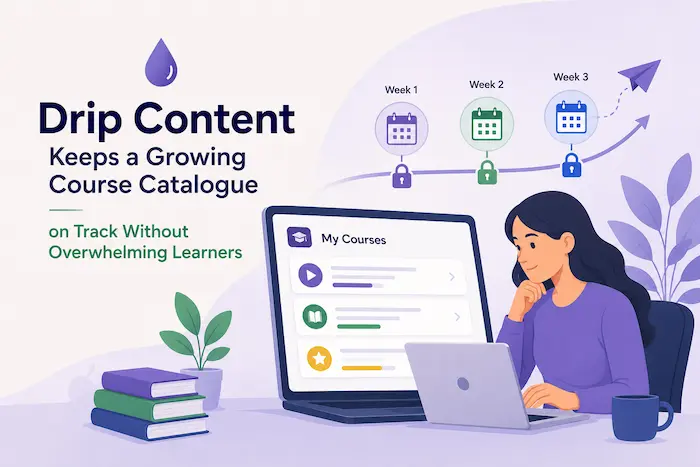
| Drip content keeps a growing course catalogue on track by releasing lessons in a structured sequence instead of giving learners everything at once. It reduces choice overload for learners while allowing course businesses to match release schedules to different journeys, such as self-paced courses, cohorts, memberships, and certifications. |
One business we worked with started with a single flagship course on LearnDash, and content release was simple. Someone bought it, they got everything at once. Then the catalogue grew: memberships, a cohort program, a certification track, and several self-paced courses. That one release rule now fit almost none of them.
This is where drip content stops being a setting and becomes a decision. Drip content is the scheduled release of course material over time instead of all at once.
For a growing catalogue, it is less a feature than a pacing strategy: it decides when each learner, cohort, or member reaches each lesson.
So the question for a scaling catalogue is not whether drip content works. It is where it helps, and where a single blanket rule starts working against you.
When your catalogue grows, adding more content stops improving the learning experience

More content does not automatically mean a better learning experience. For a growing course business, every new course, membership, or learning path also creates another journey you need to organize. Past a certain size, it means more ways for a learner to feel lost.
The overwhelm is not about volume alone. It is about the absence of sequence.
When everything is available at once, “everything” becomes the obstacle. Drip content removes the decision by making it for them: here is what you do this week, and here is what comes after.
If part of your catalogue is courses and part is membership, the pacing question also depends on how you sell access.
Also Read: Selling Courses vs Selling Memberships on LearnDash
What drip content does for a large catalogue, and what it doesn’t
Drip content creates structure, but it cannot fix a weak learning experience. If learners drop because the material is thin, the navigation is unclear, or the course itself lacks direction, a release schedule only delays the problem.
The value of drip content comes from giving a good learning experience the right pace. It can create a reason to return, prevent learners from facing an entire course at once, and give different audiences a more appropriate journey.
The goal is not to keep content locked. It is to release the right content at the right point in the learner’s journey.
Need more control over your learning journeys?
When standard drip rules can’t match how your courses, cohorts, and learners actually move through your catalogue, custom LearnDash development can help

How to use time-released drip content to hold engagement across a large catalogue
The practical move is to stop looking for one release rule and start thinking in release models.
Across a large catalogue, most content fits one of a few patterns. The right model depends not only on the course itself, but on how you sell and deliver it: evergreen enrollment, cohorts, memberships, or certification programs.
| Release rule | Best-fit course model | What it protects |
| Enrollment-based drip (day 0, day 7, day 14) | Evergreen self-paced courses with rolling signups | A consistent journey no matter when someone joins |
| Fixed-date drip | Cohorts and live programs | Everyone moving together, on the same week |
| Progress-based unlock | Skill ladders and certifications | Mastery before the next step, no skipping ahead |
| Tiered release over time | Subscriptions and content libraries | An ongoing reason to stay subscribed |
Enrollment-based drip is often the simplest model for an evergreen catalogue. Each learner follows the same sequence from their own enrollment date, regardless of when they join. The limitation appears when that same course also needs to support exceptions, such as a returning learner, a late cohort joiner, or a member who needs a different pace.
That is the real test of a release model: not whether it works for the average learner, but whether it survives the exceptions.
Match the release model to the course, not the catalogue

There is no single right answer to “Should I drip this?” The right choice depends on the course, the audience, and what you are trying to protect—learner focus, momentum, or access.
For a scaling catalogue, three situations cover most cases: when content should remain open, when a scheduled drip makes sense, and when access should depend on progress or cohort timing.
When open, all-at-once access is the right choice
Some courses should not be dripped at all. Reference material, quick-win courses, and anything a buyer expects to use immediately work better fully open. If the value is “get in and get the answer,” a drip only frustrates. For a membership where the value proposition is ‘access everything you need’ – a professional resource library, a template bank, a tool collection. A drip schedule actively contradicts the reason someone subscribed. The release schedule becomes the churn driver
When a scheduled drip is the right choice
Scheduled drip fits when momentum matters more than speed. Cohorts, onboarding programs, and challenge-style courses rely on everyone moving together. A fixed-date release keeps a group in sync and gives your community and live sessions something to organize around.
When progress-based or cohort gating is the right choice
Progress-based gating fits when order is not optional. Certifications, compliance tracks, and skill ladders need mastery before the next unlock, so the rule is completion, not time. At WisdmLabs, we built a staged certification workflow along these lines for a client that cut essay review time by 70%.
Most catalogues use all three at once. That is where standard tools start to strain.
Where standard LearnDash drip rules stop being enough
Default drip content works well when a course has one clear audience and one clear release schedule. The problem starts when the same course has to serve learners who are no longer following the same journey.
Consider an eLearning business that started with a self-paced course. New learners could enroll at any time and receive lessons on a simple day-based schedule. As the business grows, the same course may become part of a membership, a cohort program, or a certification path.
A cohort might need everyone to unlock Week 3 on the same date, while a self-paced learner should reach Week 3 based on their enrollment date. A certification learner may need to complete an earlier lesson before the next one becomes available.

For a growing course business, that creates an operational problem as well as a learner-experience problem. Your team may have to manually adjust access for new cohorts, handle exceptions for members, or maintain separate course versions just to keep different learner journeys moving.
At scale, that manual work becomes more than an operational inconvenience—it can put a ceiling on how frequently you can launch new cohorts and, ultimately, how much revenue those launches can generate.
For a business selling cohort enrolments at $500 to $2,000 per seat, the ceiling on how frequently you can launch a new cohort is partly set by how long it takes to manually configure access for each one. That is where a release model problem becomes a growth constraint
.
That is where a single drip rule starts becoming a limitation. You may find yourself adjusting schedules manually, creating duplicate courses for different audiences, or adding workarounds simply to make the release logic fit.
Before changing anything, look at your own catalogue:
- Do learners in different programs need different release schedules?
- Are you manually adjusting access when a new cohort starts?
- Does the same course behave differently for members, self-paced learners, and certification students?
- Have you created duplicate courses simply because one release schedule could not serve everyone?
If the answer is yes to several of these, the problem may not be your content or your learners. Your release model may have outgrown the way your business now works.
Related Read: How to Create a Membership Site Using LearnDash
Has your LearnDash setup outgrown standard drip rules?
When different courses, cohorts, and learner journeys need different access logic, custom LearnDash development can help you build a setup that works at scale.

| :Is Your Drip Content Setup Ready to Scale?
Give yourself 1 point for every “Yes.” 1. Do different learner groups need different release schedules for the same course? (Yes / No) 2. Does your team manually adjust course access when a new cohort starts? (Yes / No) 3. Does the same course behave differently for self-paced learners, members, and certification students? (Yes / No) 4. Have you created duplicate courses because one drip schedule could not serve different audiences? (Yes / No) 5. Do some courses need content to unlock based on completion rather than time? (Yes / No) 6. Are your team members maintaining spreadsheets, reminders, or manual processes to manage course access? (Yes / No) 7. Has managing release schedules become a recurring task rather than a one-time setup? (Yes / No) Your score 0–2: Your setup is probably still manageable. Next action: Map your current courses by release model—open, enrollment-based, fixed-date, or progress-based—and review again as your catalogue grows. 3–5: Your release model is starting to show strain. Next action: Identify the 2–3 courses creating the most manual access work and document how each learner type should move through them. That gives you a concrete brief for fixing the underlying release logic. 6–7: Your release model has likely outgrown standard configuration. Next action: Audit your access and release logic across the catalogue and scope the custom LearnDash functionality needed to support your learner journeys without manual intervention. |
Conclusion
Drip content becomes a business decision the moment your catalogue serves more than one type of learner on the same platform. And most growing LearnDash businesses reach that point before the catalogue is half the size the business eventually reaches.
Before changing your LearnDash setup, map your catalogue by release model. Mark each course as open access, enrollment-based, fixed-date, or progress-based. Then flag the courses where your team is manually changing access, creating workarounds, or maintaining separate versions to make the release schedule work.
That gives you a clearer starting point. If the issue is limited to a few courses, fix those specific gaps. If the same problem appears across multiple learner journeys, look at the underlying release logic rather than adding another workaround.
The goal is not to make every course follow the same pacing model. It is to make your LearnDash setup reflect how your learners actually move through your catalogue.
Explore LearnDash customization with WisdmLabs →
FAQ
What is the difference between drip content and a cohort course?
Drip content is the mechanism, releasing lessons on a schedule. A cohort course is a model, a group moving through together on fixed dates. Cohorts usually use drip content, but you can drip an evergreen self-paced course too, paced from each learner’s own enrollment date rather than a shared calendar.
Can LearnDash drip content run different schedules for different learners?
By default, LearnDash drip content assumes one schedule per course, by date or by enrollment. Running genuinely different schedules for different cohorts, tiers, or groups inside the same course usually needs custom logic or an extension. This is one of the most common reasons scaling course businesses move beyond stock configuration.
Should I drip every course in my catalogue?
No. Reference material, quick-win courses, and searchable membership libraries are usually better fully open. Drip the courses where sequence or momentum matters, such as onboarding, cohorts, and certifications, and leave the rest open. Dripping everything by default is the fastest way to frustrate learners who came for one specific answer.