


| In Brief
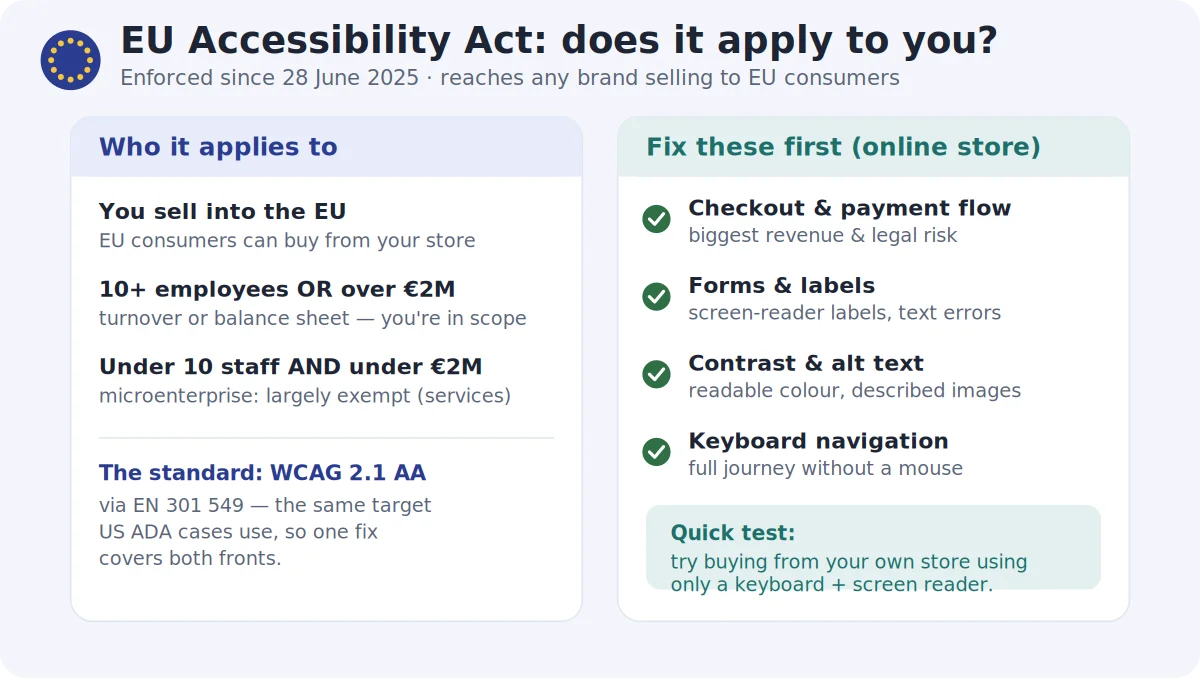
The EU Accessibility Act has applied since 28 June 2025, and it reaches any business selling to EU consumers, US companies included. If you sell a covered service like e-commerce to EU consumers, it likely applies; the main relief is a microenterprise exemption for the smallest service providers. The standard is WCAG 2.1 Level AA. Below: who’s in scope, what to fix first, and how real enforcement is. |
If you sell into Europe, a law you may never have heard of now applies to your website. The European Accessibility Act became enforceable on 28 June 2025. And like GDPR, it reaches past Europe’s borders to any business serving EU customers.
A year in, the first enforcement actions have landed, so it’s worth working out whether it’s your problem.
This guide sticks to addressing the practical questions for ambitious, scaling business owners: does this apply to me/my company, what do I have to fix, how serious is enforcement, and where does it genuinely not matter.
What the EU Accessibility Act actually is (and why a US business is affected)
The European Accessibility Act (formally Directive (EU) 2019/882) is an EU law that requires a defined set of products and services to be accessible to people with disabilities. It was adopted in 2019, member states had until 2022 to write it into national law, and its requirements became enforceable on 28 June 2025.
The part that catches US brands off guard is its reach. The Act applies based on where you sell, not where you’re based. According to Bird & Bird’s analysis, the obligations extend to any operator placing covered products or services on the EU market, regardless of headquarters. If EU consumers can buy from you, you’re in the same position as an EU company.
Covered services include e-commerce, which the directive defines broadly enough to capture most online selling to consumers. So a US store shipping to customers in Germany, France, or Ireland is squarely the kind of business the law was written for.
Does this really apply to you? The honest applicability test
This is worth pinning down carefully, because the exemptions are what determine whether you need to act at all.
The main exemption is for microenterprises that provide services.
Under the EU’s definition, a microenterprise employs fewer than 10 people and has annual turnover (or a balance-sheet total) not exceeding €2 million.
You keep the exemption only if you meet both tests.
Cross either one, by reaching 10 employees or by going over €2 million, and it no longer applies. A $1M+ operator with a real team is very likely over that line and in scope.
There’s a second relief valve
The “disproportionate burden” clause. If compliance would impose a genuinely excessive cost relative to your size and resources, you can claim partial relief. But you have to document and justify the assessment, and regulators can challenge it.
Treat it as a narrow, evidenced exception, not a way out.
So here’s a quick test.
If EU consumers can buy from you, and you employ 10 or more people or exceed €2 million in turnover or balance-sheet total, plan to comply.
If you’re under both the headcount and the financial ceiling, you likely qualify as an exempt microenterprise. Though the goodwill and US-side reasons below may still make the work worthwhile.

What “accessible” means here, in plain terms
The Act itself is written in outcomes rather than code.
In practice, conformance is measured against the harmonised European standard EN 301 549, which for websites and apps points to the Web Content Accessibility Guidelines, WCAG 2.1 at Level AA.
If that’s a wall of acronyms, here’s the plain version.
WCAG is the widely accepted international rulebook for making digital content usable by people with disabilities.
This includes those using screen readers, keyboard-only navigation, or high-contrast settings. Level AA is the middle and most commonly required tier. It’s the same standard US courts lean on, which matters for the two-fronts point later.
One extra obligation worth noting.
Covered businesses are expected to publish an accessibility statement describing how their service meets the requirements and how users can flag problems. It’s a visible signal of compliance and one of the simpler things to get right.
What to fix first (a risk-prioritised list for an online store)
You don’t have to boil the ocean. For an online store, accessibility problems cluster in a few high-traffic, high-liability places, and that’s where to start.
The checkout and payment flow comes first. If a shopper using a screen reader or keyboard can’t complete a purchase, that’s both your biggest revenue leak and your clearest legal exposure. Test the entire path from cart to confirmation.
Forms come next: labels that screen readers can announce, errors that are described in text rather than colour alone, and fields that can be completed with a keyboard.
Then the fundamentals across the site: sufficient colour contrast, meaningful alt text on product images, a logical heading structure, and full keyboard navigation. Video needs captions.
A practical way is to stop using your mouse and try to buy something from your own store using only the keyboard, then repeat it with a screen reader turned on. The failures surface fast.
When the fixes go beyond small tweaks and start touching templates and layouts, that’s a redesign, which is worth scoping deliberately rather than patching piecemeal.
Does your site need more than a quick patch?
When compliance means rebuilding inaccessible pages, we help you redesign them properly, on WordPress or WooCommerce.
The US ADA angle: one investment, two fronts
If you’re a US business, you may already have accessibility on your radar for a different reason: ADA website lawsuits. This is where the EU work pays a second dividend.
US courts have seen a steady stream of lawsuits arguing that inaccessible websites violate the Americans with Disabilities Act. Demand letters over screen-reader incompatibility are now a routine cost of selling online.
Separately, the Department of Justice finalized a 2024 rule setting WCAG 2.1 AA under ADA Title II, with deadlines arriving in 2026 and 2027.
One clarification, because it’s widely muddled: ADA Title II covers government entities, Title III covers private businesses. The 2024 DOJ deadlines apply to Title II, so a private store shouldn’t treat them as its own deadline.
The parallel still matters because of the standard: EU rules and US litigation both target WCAG 2.1 AA, so remediation for Europe largely doubles as ADA protection at home.
How real is enforcement? (an honest read)
Penalties exist, they vary by country, and enforcement has started, though unevenly. Being straight about that is more useful than a blanket “you’ll be fined.”
Because the directive is enforced through national laws, the ceilings differ by member state.
Germany’s implementing law (the BFSG) allows fines up to €100,000.France’s provides for penalties reaching into the tens of thousands or tied to revenue. Italy’s permits sanctions up to 5% of turnover in serious cases.
Figures vary by source and by the violation, so treat them as national ranges, not a single EU-wide number.
Enforcement is also becoming concrete. As reported by AudioEye, French disability-rights groups issued formal notices to major retailers within days of the deadline, and a French court ordered Carrefour to make its online services accessible within six months or face daily penalties.
So, in a nutshell, enforcement is real and building, currently strongest in a few active member states, and trending toward more scrutiny.
Not sure where your site stands?
Ask our free WordPress Consultation Bot for a quick, no-obligation read on your site and where to start
When this is genuinely low-risk for you (the counterpoint)
Not every business needs to drop everything, and it’s worth saying so plainly.
If you’re a true microenterprise, under 10 employees and under the €2 million financial ceiling, the service-provider exemption means the legal pressure is minimal.
If you don’t sell to EU consumers at all, the EAA doesn’t reach you, though US ADA points may still apply. And if EU sales are a negligible slice of a small operation, a phased approach beats an expensive emergency rebuild.
None of this argues for ignoring accessibility, which pays off in reach and usability whatever the law says. The point is to act proportionately, matching the size of your response to your actual exposure rather than to the level of alarm around the topic.
What to do next
Three concrete steps, in order.
First, run the applicability test honestly: your headcount, your turnover, and whether EU consumers buy from you. That tells you whether this is urgent or optional.
Second, if you’re in scope, test your checkout and forms with a keyboard and a screen reader, and fix those before anything else, because that’s where revenue and liability concentrate. Publish an accessibility statement while you’re at it.
Third, decide whether this is a maintenance task or a rebuild.
If your theme and templates are fundamentally inaccessible, patching around them tends to cost more over time than doing it properly once. K
Keeping a site conformant is also ongoing, not one-and-done. This is where ongoing website management earns its place. Because standards and your own website both keep changing.
FAQ
Does the EU Accessibility Act apply to US companies?
Yes, if you sell to EU consumers. The Act applies based on where your customers are, not where your business is registered, in the same extraterritorial way as GDPR. A US online store shipping to EU customers is generally in scope unless it qualifies as a microenterprise, which requires meeting both the employee and the financial threshold.
What is the deadline for the European Accessibility Act?
The Act became enforceable on 28 June 2025. There is a transitional period running to 28 June 2030 for certain service providers to bring legacy systems into line, but new services and most consumer-facing e-commerce were expected to comply from the 2025 date.
Which accessibility standard does the EAA require?
Conformance is assessed against the European standard EN 301 549, which for websites and apps aligns with WCAG 2.1 Level AA. That is the practical target to build and test against, and it is also the standard most commonly referenced in US accessibility matters.
What are the penalties for non-compliance?
Penalties are set by each member state, so they vary. Reported ceilings include up to €100,000 per violation in Germany and sanctions tied to turnover in some countries such as Italy. Amounts differ by source and by the severity of the breach, so treat published figures as national ranges rather than a single EU-wide fine.
Is complying with the EAA the same as ADA compliance?
Not identical, but closely related. Both converge on WCAG 2.1 AA as the technical standard, so accessibility work done for the EU largely reduces US ADA-lawsuit exposure too. The legal regimes and enforcement mechanisms differ, but the remediation on your website is substantially the same.
The bottom line
The European Accessibility Act turned good practice into a legal requirement for a large share of businesses selling into Europe, US brands included.
The sensible response is neither to panic nor to reach straight for an off-the-shelf accessibility widget.
Start with a clear-eyed applicability check, then focus on the places that carry the most revenue and risk: checkout, forms, and the fundamentals, measured against WCAG 2.1 AA.
Done properly, that work does double duty, meeting the EU requirement while lowering your US ADA exposure at the same time.
If you want a straight assessment of what your specific site needs, and a plan that matches your actual exposure rather than the scariest headline, talk it through with us and we’ll help you figure out the right next step.