


| Enterprise WordPress means running WordPress as a governed platform: a curated plugin set, controlled provisioning, and a real migration path, not a one-off website. In June 2026, CERN moved its flagship site, home.cern, from Drupal to WordPress and now runs roughly 580 sites on that model. For a scaling brand, the lesson isn’t “WordPress won.” It’s what CERN built underneath the CMS. |
On a stage in Kraków this June, CERN’s web manager said one sentence that made the room go quiet
It went: home.cern was now running on WordPress. This is the flagship site of the organization that invented the web, not some side project, and you can see it live at home.cern today.
That move brought an old argument back to the surface.
Scaling businesses have gone back and forth for years on whether WordPress is a serious platform to build on, or whether it quietly runs out of room as a company grows. CERN’s choice doesn’t settle that on its own.
What’s worth a closer look is the reasoning behind it: why they moved, what they built to make it work, and where that holds up for a business at your scale.

What CERN actually did (and why the room went quiet)
CERN migrated its main site off Drupal and onto WordPress, live.
The announcement came during the opening keynote at WordCamp Europe 2026, which ran June 4 to 6 in Kraków and drew 2,458 people from 81 countries.
The people behind it were Joachim Valdemar Yde, who manages CERN’s web team, and Francisco Borges Aurindo Barros, who leads its WordPress infrastructure.
Yde’s line was the one that landed: “As of today, our main flagship website, home.cern, is now served on WordPress. It’s been automatically migrated, and it’s live.”
This wasn’t a single-site experiment.
CERN now runs a centralized WordPress service powering roughly 580 sites, with a stated goal of migrating 800-plus in total. A core team of five to six people built it over about two and a half years.
Here’s why that matters to you: this was a deliberate, high-stakes choice, and the reasoning behind it is where the real lessons are.
Why this example carries weight
CERN didn’t pick WordPress to chase a trend, which is exactly why the move is worth studying.
It’s a research organization with strict security, accessibility, and uptime demands. And it put WordPress at the centre of its web presence after a structured, multi-year review rather than a quick preference call.
A careful decision made under real constraints tells you far more than a list of well-known brands that happen to run the platform.
That said, it doesn’t mean WordPress is the right answer for everyone. CERN’s needs are specific, and so were its reasons, which we’ll get into below.
We at WisdmLabs build WordPress platforms at this level, so the goal here is to be straight about what holds up under scrutiny and where the honest caveats sit.
Is WordPress actually scalable, or just popular?
Yes, WordPress is scalable.
But scale is an outcome of architecture, not something the platform hands you for free.
The same install that runs a hobby blog can run a high-traffic platform. The difference is what surrounds it: hosting, caching, a content delivery network, and disciplined code.
Popularity and scalability get confused because WordPress is everywhere.
Depending on the source and the month, W3Techs puts WordPress at roughly 41.9% to 43.5% of all websites. That figure tells you it’s common. It doesn’t tell you it’s serious.
The number that answers the scale question is different.
W3Techs also reports WordPress running close to half of the top one million sites by traffic. The “WordPress is only for small blogs” line doesn’t survive contact with that data. The busiest, most demanding sites use it heavily.
What the “WordPress is dying” charts miss
You may have seen charts showing WordPress share slipping, down to around 41.9% from a 43.5% peak. Clients forward us these and ask if they should jump to a no-code builder.
Look closer at who’s actually gaining. It isn’t a rival CMS. The share shift is driven mostly by sites that need no CMS at all, which dilutes every platform’s slice.
As one WordPress agency owner put it bluntly, an ecosystem losing relevance doesn’t draw several thousand people to its own conference. Kraków was packed.
Whether WordPress is a safe bet for your business and what fraction of all websites it holds this quarter are two different questions. Only the first one should shape your decision.
What CERN built underneath the CMS: the part that matters
The most instructive part of the CERN story has little to do with the CMS they picked. It’s in the operating model they built around it.
According to CERN’s public roadmap, the platform gives anyone at CERN a self-service portal to request a site in a few clicks. Behind that sits a shared setup: one common theme, a curated and security-hardened set of plugins, and new sites spun up automatically in about a minute.
Provisioning just means creating a new site in a controlled, repeatable way, instead of building each one by hand.

Four things define that model: a governance board that decides what’s allowed, a curated plugin set everyone shares, automated provisioning, and an automated migration path. Notice what’s missing. There’s no mention of a clever theme or a flashy feature. The value sits in the boundaries.
A governed plugin set, not a plugin free-for-all
CERN reviews every plugin before it’s allowed in. Nobody installs whatever they like. That single rule removes the most common way WordPress sites rot.
There’s a solid reason for that rule. Industry data attributes the large majority of WordPress vulnerabilities, commonly cited around 97%, to plugins and themes rather than core software.
The core itself is well-maintained. Most of the risk comes from what you add on top of it.
The threat is real and current. In one 2026 incident discussed on Hacker News, an attacker bought roughly 30 plugins and planted a backdoor across all of them. If your site runs unvetted plugins, that’s your attack surface — and this is why SaaS security practices that govern which third-party tools are allowed, monitored, and reviewed apply as much to a WordPress plugin stack as they do to a broader enterprise software portfolio.
A curated plugin set is the cheapest security upgrade most growing sites never make. Keeping that list short and reviewed is what our website management services handle for teams that would rather not police it.
Provisioning and migration as a system
CERN’s migration is automated end-to-end. A single command lifts pages, headings, and images from Drupal and rebuilds them as WordPress blocks, with no downtime, and the team said they plan to open source the tool.
The detail that should reassure any scaling operator: the original site stays live until the owner approves the new one, and URLs are preserved. That answers the fear we hear most often, echoed in a CERN user forum thread where a site owner asked how to move platforms while keeping the same URL.
Broken links and lost search rankings are the real nightmare. A proper migration treats them as non-negotiable, which is the standard we hold our own WordPress migration services to.
Migrating off a legacy platform?
We help you plan and run WordPress migrations that keep your URLs, SEO, and data intact, the automated, low-risk way CERN did it.
Enterprise WordPress is about how you run it, not how big the theme is
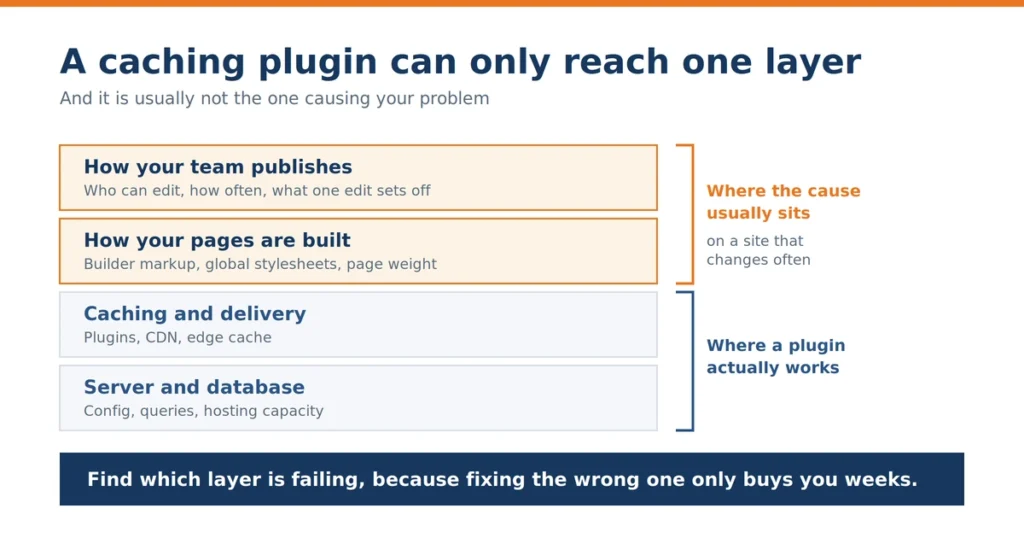
Here’s the shift in thinking that matters. Running WordPress at scale has little to do with a fancier design or a heavier plugin stack. It comes down to how you run the platform: keeping clear boundaries between content, presentation, and integrations, and setting rules about who can change what.
When we get called in to fix a struggling site, the problem is rarely the platform itself. It’s how the site has been governed.
A plugin added for one campaign that unknowingly breaks a checkout. A theme so customised that every update needs manual testing. An agency handoff that starts by reverse-engineering the last one’s work. That pattern shows up the moment a site outgrows its setup, the same way stock WooCommerce starts creaking past $1M in revenue.
The way out is to stop treating your website as a one-time build and start running it as a system you maintain on purpose: owned, governed, and kept current, rather than shipped once and left to drift.
If you want that discipline built in from the start, it’s the core of our WordPress development services.
A quick checklist: are you running a system or a one-off build?
Run your current setup against this. Every “no” is a gap worth closing before it becomes an incident.
- Plugin policy. Is there a written list of approved plugins, and does someone review new ones before they go live?
- Update discipline. Are core, theme, and plugins updated on a schedule and tested in staging first?
- Clear ownership. Is one person or partner accountable for platform health, not just publishing content?
- A real migration and backup path. If you had to move or restore the site tomorrow, is the process documented and tested?
- Boundaries. Are content, design, and custom logic separated enough that one change doesn’t break three others?

Score mostly “yes” and your foundation is solid. Score mostly “no” and you’re carrying a risk you can’t see yet.
See what governed WordPress looks like in practice: How we rebuilt reporting and user management for a training platform: roles, permissions, and control at scale. Read the Case Study →
Not sure where your WordPress setup stands?
Get a good starting point with our free WordPress Consultation Bot for a quick, no-obligation read on your platform's scalability and gaps
WordPress vs Drupal: what CERN’s move does and doesn’t tell you
It’s tempting to read CERN’s decision as “WordPress beats Drupal.” That’s the wrong lesson, and an honest look at why matters.
CERN moved for specific reasons. Drupal 10 is reaching the end of its life in late 2026, which has forced the question.
On top of that, they were maintaining 300-plus bespoke modules across 200-plus sites, a load that had grown faster than the team could carry. Those are real, situation-specific pressures.
Drupal remains a strong CMS, especially for deeply structured content and granular access control out of the box. “WordPress won at CERN” is not, on its own, a reason for you to move.
If your current platform is delivering and you face no end-of-life deadline or runaway maintenance load, you can wait, plan, and pick your moment. The trigger should be your pressures, not someone else’s headline.
When moving to WordPress is worth it, and when it isn’t
Different readers arrive here from different places. The right answer depends on where you’re starting.
| Your situation | The signal to watch | Sensible next move |
| Already on WordPress, growing fast | Updates feel risky; plugins pile up; no clear owner | Mature the setup, add governance, don’t replatform |
| On Drupal or a legacy CMS | End-of-life deadline or maintenance load outgrowing the team | Plan a migration; preserve URLs and data |
| On a closed SaaS platform | Rising fees, slow release cycles, or lock-in blocking growth | Evaluate the total cost, then move deliberately |
| Choosing a platform for a new build | You need long-term flexibility without enterprise licensing | Start on a governed WordPress foundation from day one |
The through-line: don’t move because of a trend, and don’t stay out of inertia. Both are decisions. Make yours on evidence, the way CERN spent over a year evaluating options before committing.
| If you’re already on WordPress and the honest answer is “mature it, don’t move it,” the work is usually about maintenance and ownership. Our guide to WordPress maintenance covers the baseline, and the difference between maintenance and full website management is worth understanding before you decide who owns your platform |
How to borrow CERN’s discipline without CERN’s headcount
You don’t have five to six full-time platform engineers. You don’t need them. What you need is the model, applied at your scale.
What sets CERN apart comes down to ownership rather than budget: someone there owns the standards and actually enforces them.
For a scaling business, that ownership can sit with a partner rather than a full-time hire, giving you the governed plugin set, the update discipline, and the migration path without carrying the cost of an in-house team.
For most growing businesses, that works out better than stitching together freelancers, an agency, or a retainer piecemeal.
If you want a quick, no-obligation read on where your current setup stands before talking to anyone, our free WordPress Consultation Bot can give you a starting point in a couple of minutes.
At WisdmLabs, we’ve built and governed WordPress platforms for scaling course businesses and stores that needed to grow without rebuilding every year.
The principle is the same one CERN proved at a far larger scale: the boring layer, the part that handles governance, updates, and migrations, is what keeps a platform dependable.
FAQ
Is WordPress secure enough for a large or high-traffic business?
Yes, when it’s hardened and governed. WordPress core is well-maintained; the majority of vulnerabilities, commonly cited at around 97%, come from plugins and themes. A curated plugin set, scheduled updates, and managed hosting close most of that gap. Security is an implementation choice, not a platform limitation.
Is WordPress or Drupal better for a big site in 2026?
It depends on your needs. Drupal offers more granular content modelling and access control out of the box, which suits highly structured data. WordPress offers a larger ecosystem, easier editing for non-technical teams, and lower total cost of ownership. CERN chose WordPress partly because Drupal 10’s end of life forced the decision, not because one is universally better.
Can WordPress handle enterprise-level traffic without going down?
Yes, with the right architecture. High-traffic WordPress sites rely on managed hosting, object caching, a CDN, and load balancing. Roughly half the top one million sites by traffic run WordPress, which shows the ceiling is well above where most businesses operate. Downtime usually traces back to weak hosting or unvetted plugins, not the platform.
Do I need WordPress VIP to run WordPress at scale?
Not necessarily. WordPress VIP is a fully managed enterprise tier suited to very large publishers and organisations with strict compliance needs. Most scaling businesses reach enterprise-grade reliability with quality managed hosting, a governed plugin set, and a maintenance partner, at a fraction of the cost.
How hard is it to migrate off Drupal or another CMS without breaking URLs?
It’s very doable with the right plan. CERN’s automated migration preserved URLs and kept the original site live until each new one was approved. Preserving URLs and redirects protects your search rankings, so it should be treated as a requirement, not an afterthought. The complexity depends on how customized your current site is.
The takeaway
CERN’s move doesn’t tell you WordPress is the best CMS.
What it shows is more useful: WordPress holds up as serious infrastructure when you build a real operating model around it, with governance, a curated plugin set, controlled provisioning, and a tested migration path.
Those are the things that keep a growing site dependable over the years, not just at launch.
You can borrow all of that thinking at your own scale, without CERN’s team. Whether WordPress can carry a growing business is fairly well settled at this point.
The real question is whether yours is being actively maintained to keep growing or slowly accumulating the kind of neglect that ends in an expensive rebuild.
If you’d like a clear-eyed read on which one you’re running, talk through your platform build with us.
It usually starts with a short call where we look at your actual setup, not a pitch. These are the things we try to understand from you:
- What’s on your plugin list
- How updates get made
- Who owns the thing when it breaks, etc
From there, you get an honest read on whether your platform needs maturing or replatforming, and a plain-language scope if there’s work worth doing, before you commit to anything.
Or if you’d rather just ask a few questions first, get in touch and we’ll take it from there.