

The price difference between a basic five-dollar notebook and a forty-dollar “Strategic Planning System” usually has nothing to do with the thickness of the paper. It is almost entirely about how much the buyer believes that a specific book will finally help them organize their life.
Let’s be real. Setting up a WooCommerce store today is so easy that it is almost a liability. With a few clicks and some AI-generated product descriptions, anyone can launch a storefront filled with the same generic items as everyone else. But when technology makes it effortless to start, it also makes it effortless to blend in. If your only strategy is to be the cheapest person on the page, you are essentially volunteering to be crushed by global retail giants.
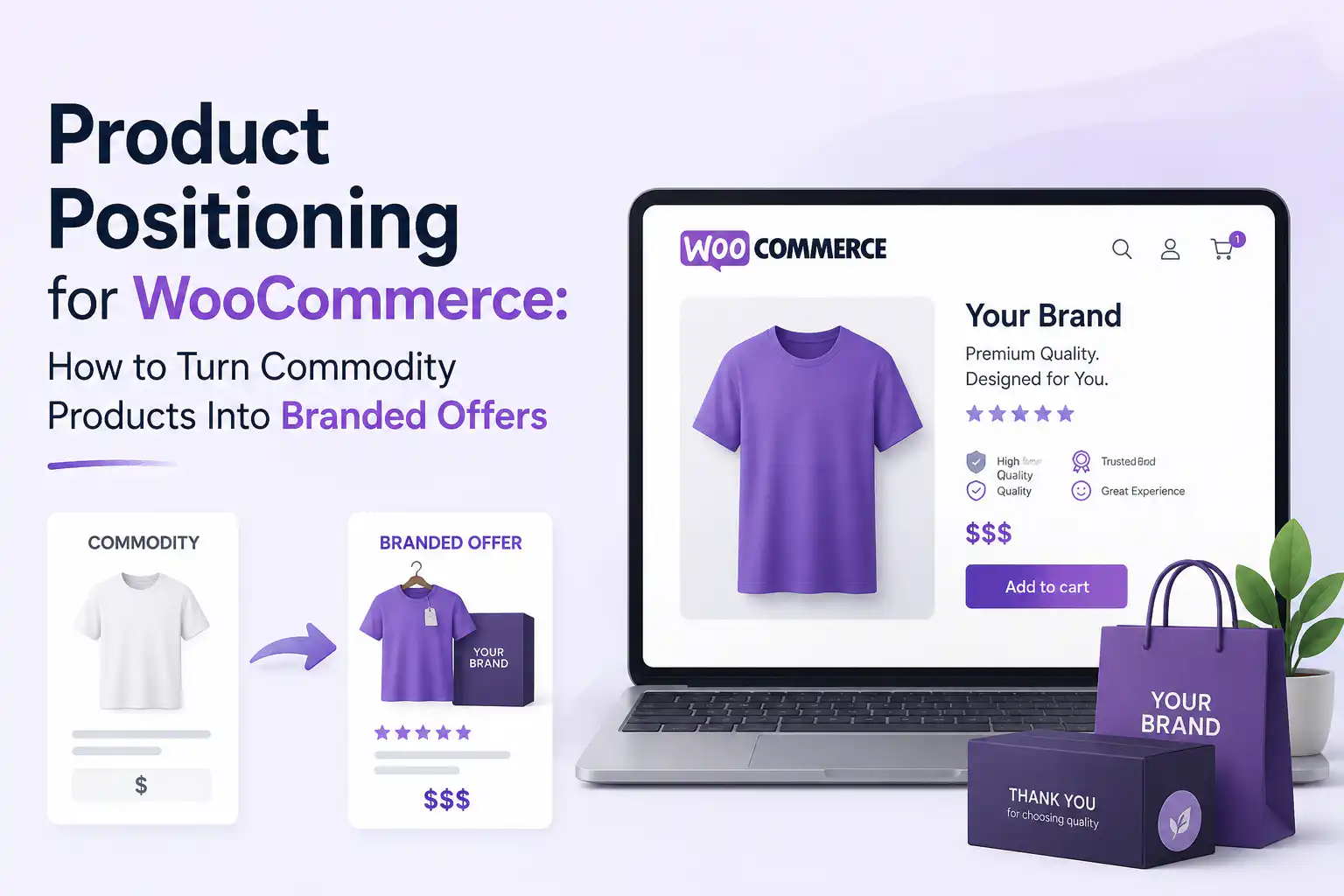
To build a brand that lasts longer than a fleeting social media trend, you have to stop moving inventory and start selling an identity. This is where product positioning for WooCommerce becomes essential. It is how you shift from being a middleman to being a curator. Here is the blueprint for using strategic positioning, intentional bundling, and actual human personality to turn standard commodities into offers people actually want to buy.
Selecting a High-Stakes Niche
Trying to sell to everyone is a fast way to ensure your marketing budget disappears without a trace. When you cast a net that wide, you are effectively trying to out-shout retail giants with billions in capital. For an independent WooCommerce store, that is a battle you will lose.
Profitable ecommerce brand positioning starts by shrinking your audience until you are the only logical choice for a specific group of people. This strategy works because it addresses the rising cost of customer acquisition. In a world where advertising feels more expensive every day, the only way to protect your margins is to ensure your conversion rate is significantly higher than the industry average. You achieve that by being intensely relevant to a tiny subset of the market.
The success of YETI provides a perfect look at how this works. Back in 2006, Roy and Ryan Seiders realized that hunters and anglers didn’t need another discount product.

They needed a cooler that could survive a week in the back of a truck or on a deep-sea fishing boat without falling apart. By aiming specifically at people who valued performance over a low price tag, they turned a basic plastic box into an essential piece of equipment.
Value is always determined by context. A cooler is just a commodity at a backyard barbecue. It becomes a mission-critical tool on a remote fishing trip. When you speak directly to a subculture rather than the general public, you stop being a replaceable vendor and start being a trusted resource. That is the core principle behind product positioning for WooCommerce. The product does not need to be revolutionary. The context around it needs to be specific enough to make the buyer care.
Executing the Private Label Pivot
Building a premium brand rarely means inventing something new. Most founders win by shaping how a product is experienced, not by reinventing the product itself. Private labeling gives you that control. You take something that already works and turn it into something people actually care about.
What people buy rarely comes down to the raw product. It comes down to how it fits into their life.
Coffee is a simple example. Beans are widely available. Still, people happily pay extra for brands that match their routine, their vibe, or even how they want to see themselves. That morning cup carries more weight than just caffeine. It feels like a small ritual that sets the tone for the day. Private labeling lets you tap into that layer, which is why it plays such an important role in any serious WooCommerce branding strategy.
By using a fulfillment partner to handle the logistics, you can focus on positioning and product selection, especially when working with high-demand consumable goods that benefit from strong branding and customer loyalty.
You are not stuck figuring out roasting, storage, or shipping. A fulfillment partner handles that in the background. You stay focused on the parts customers actually notice. The look, the tone, the story, and the overall experience. That changes how you build the business.
You can spend time understanding who you are selling to instead of worrying about inventory. You can shape your messaging so it feels like it belongs to a specific group of people. You can design packaging and visuals that feel consistent from the first click to the moment the product lands in their hands.
Take that same instant coffee and aim it at backcountry campers. Show it being brewed on a cold morning in the mountains. Use language that sounds like it comes from someone who actually hikes those trails. Make the packaging tough enough to survive a backpack. Now it fits into their world.
The product has not changed much. The way it shows up in someone’s life has. That shift does the heavy lifting. People stop comparing it to the cheapest option online because it no longer feels interchangeable.
This is product positioning for WooCommerce in action: changing the perceived value of a familiar product by changing the role it plays in the customer’s life. Once that connection clicks, you are no longer just another store selling coffee. You are the brand they reach for without thinking.
Implementing Strategic Bundling
Consumers compare identical products on price because it is easy. Bundling allows you to sell an outcome instead of a line item, which shields your store from aggressive price wars. When you create a unique combination of goods, you make it almost impossible for a buyer to perform a direct price comparison.
The strategy works because it removes the mental friction of sourcing separate items. Cosmetic brands often use this to move away from individual product sales. For instance, Murad offers a “3-Step Glow Bundle” that highlights a significant discount compared to buying the items individually. Customers are usually looking for a specific visual result. They are buying a glow ritual exclusive to that brand.

Meal-delivery companies like HelloFresh build their entire model on this concept. They provide a complete solution with a recipe and pre-measured ingredients. The value arises from the convenience and the finished meal. This makes it difficult for a customer to compare the box price to a pile of loose groceries at a local supermarket.

For a WooCommerce store, this might mean pairing a physical item with an accessory and a digital guide as part of a sharper WooCommerce branding strategy. Once your kit solves a specific problem, there is no cheaper alternative for the customer to find elsewhere. You have shifted the conversation from the cost of the parts to the value of the transformation.
Building a Storytelling Moat
If your product page is just a neat list of materials and dimensions, you’re basically handing your customer a checklist to go find the cheapest alternative.
And now it’s even worse. AI can generate clean, perfectly structured product descriptions in seconds. Which means “well-written” is no longer impressive. If your copy sounds like it could belong to any brand, it probably will.
What actually makes people choose you is context. Why does this product exist? Who is it for? What problem does it really solve in someone’s life?
That is where storytelling strengthens your e-commerce brand positioning and creates a defensible moat. A narrative gives your customer a reason to choose you that has nothing to do with the price tag. Patagonia provides a masterclass in this approach. They famously ran a “Don’t Buy This Jacket” campaign to highlight their stance on environmental waste.
On the surface, telling people to avoid your product seems like a terrible business move. In reality, it reinforced their promise to save the planet. Customers started seeing a Patagonia jacket as a badge of environmental commitment rather than just a piece of outdoor gear. That authenticity helped them build a billion-dollar brand because people wanted to be part of the mission.
When you infuse your WooCommerce shop with a specific saga, you invite the customer to become a character in your brand’s story. They aren’t just clicking a buy button. They are aligning themselves with your values. That emotional connection is impossible for a generic competitor to replicate, no matter how much they undercut your pricing.
Owning Your Distribution Channels
Most generic storefronts operate at the mercy of algorithms. They don’t actually own their audience; they simply rent attention from massive tech monopolies at a high interest rate. Every single sale requires paying a toll to social media platforms in the form of ad spend. When ad costs spike or a feed algorithm changes, those thin profit margins vanish overnight.
Niche brands fundamentally flip this power dynamic. Because you are catering to a specific passion or problem, you can successfully transition from renting attention to owning your distribution channels. A generic gadget store struggles to build an email list because, frankly, nobody wants a weekly newsletter about random plastic trinkets. However, a WooCommerce store selling specialized gear to urban beekeepers has zero problem getting people to subscribe.
The audience actually wants to hear from you. They want the tips, the community updates, and the first look at new arrivals. By building a robust email list or a private community server, you insulate your business from rising customer acquisition costs. When you launch a new product, you don’t have to spend five figures on “awareness” ads. You simply hit send.
Owning your distribution transforms your audience from a recurring expense into a permanent, highly profitable asset. It’s the difference between being a temporary digital kiosk and a long-term brand ecosystem.
Conclusion
At its core, product positioning for WooCommerce is about context. By narrowing your audience, curating bundles, telling human stories, and owning your distribution, you transform generic items into branded experiences that command respect and profits. When you embrace identity over inventory and lean into positioning, even a cup of coffee can become a cult object.