

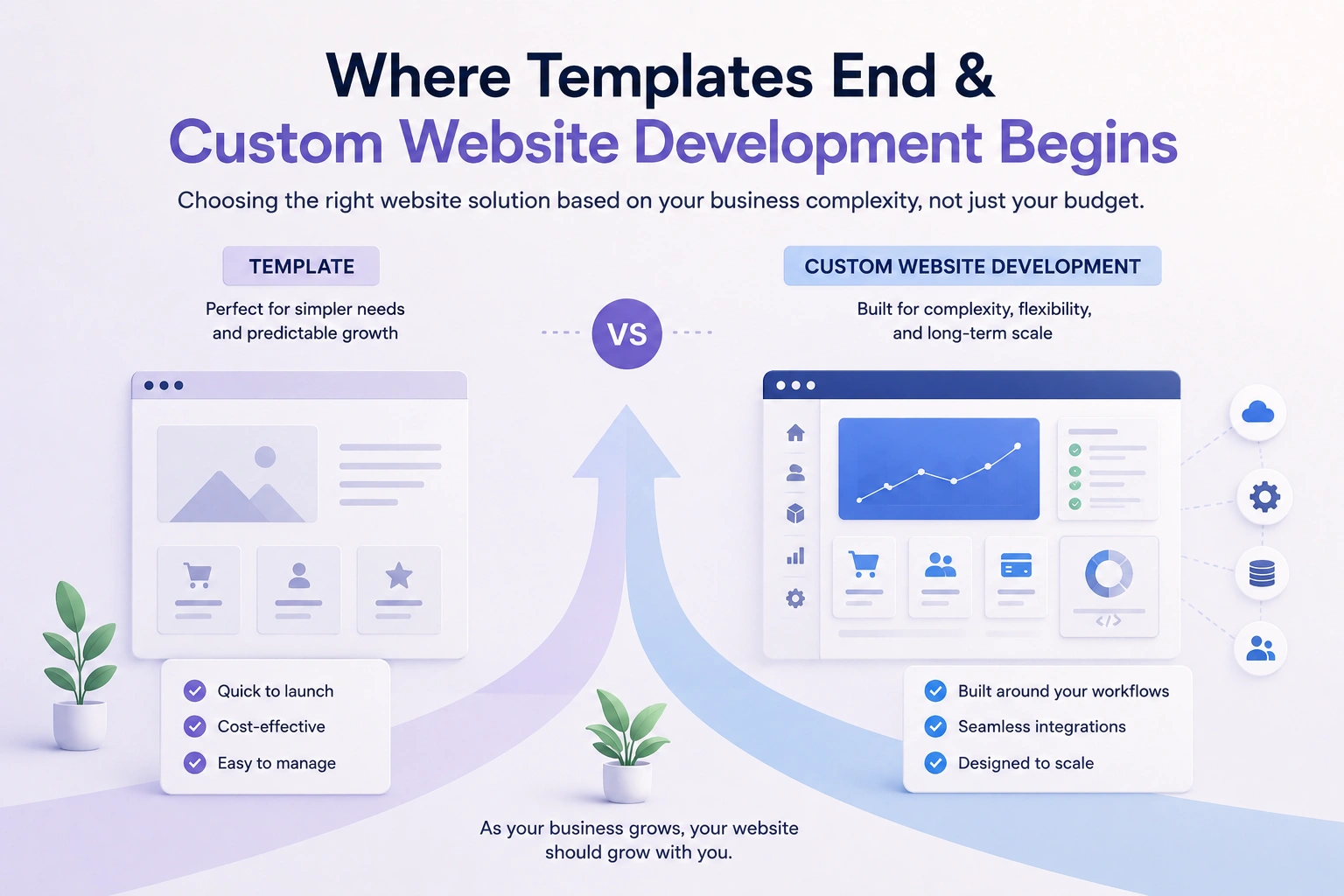
| The debate around custom website design vs template isn’t really about design, it’s about whether your current website can support the way your business is growing.
A custom website becomes the better choice when your business outgrows what a template was designed to support. If growth depends on custom workflows, complex integrations, evolving customer journeys, or rapid experimentation, continuing to work around template limitations often costs more than investing in custom website development. For businesses with simpler requirements and predictable growth, a well-built template can still be the right choice. |
Your team wants to launch a new pricing structure next quarter. Tiered plans, a free trial path, a referral incentive baked into checkout. The idea is solid.
The estimate from your developer isn’t three weeks, because the template’s checkout flow wasn’t built to hold logic like this.
Or it’s your course catalog. You want cohort-based programs with a different dashboard experience than your self-paced courses. Your theme can technically do it, if you’re willing to fight its structure at every step.
Neither of these is really a template problem. It’s a complexity problem, and the template just happens to be where it shows up first.
That’s true for some businesses past $1M in ARR. It isn’t true for all of them, and figuring out honestly which side you’re on is the actual point of this guide, not talking you into a rebuild.
A custom website becomes the better choice when your business outgrows the limitations of a template. If launching new features, supporting complex customer journeys, integrating critical business systems, or scaling operations requires constant workarounds, custom website development can deliver better long-term ROI.
This guide explains how to evaluate custom website design vs template still fits your business or whether it’s time to invest in a custom WordPress website design built around your growth.
A Custom Website Design vs Template Guide for Ambitious Entrepreneurs
Most custom website design vs template comparisons default to a false choice: templates are cheap and limited, custom is expensive and flexible—pick your budget. That framing was never particularly useful, and it becomes even less relevant as your business scales.
As businesses grow, so does the complexity of their digital infrastructure. New customer journeys, third-party integrations, subscription models, internal workflows, and operational requirements all place demands on a website that templates weren’t designed to handle.
That’s what ultimately determines whether a template is still enough or whether your business needs a custom website.
We’ve broken down where templates end and custom WordPress development actually begins in more technical detail elsewhere, but the short version starts with what your operations actually require, not your budget.
The real question isn’t whether your company is big enough for custom development. It’s whether your operations have gotten complex enough that a template is now the expensive option.
Company size is a weak signal here. A $3M business selling one product line can run comfortably on a well-built template for years. A $1.2M business juggling subscriptions, an LMS, and three regional storefronts might have outgrown one already. Complexity, not revenue, is what decides this.
Your Audit Says You Need More Than a Template. Now What?
The next step isn't rebuilding everything—it's understanding what your business actually needs. Our custom web design team helps businesses build websites around their operations, not around the limitations of a theme.
- Custom workflows built around your business
- Design and development handled by one team
- Flexible customer journeys
- Scalable architecture designed for long-term expansion

When a Template Is Still the Right Call at $1M+ ARR
Revenue alone doesn’t retire a template. Plenty of businesses well past $1M in ARR run their entire operation on one well-configured template, and that’s not a compromise they’re settling for. It’s the correct call for where their business actually is.
If Your Complexity Hasn’t Changed, Only Your Revenue Has
A business selling the same handful of products through the same single checkout path it used at $200K in revenue hasn’t added operational complexity just because the number in its bank account grew.
If your day-to-day operations look the same as they did two years ago, just with more traffic and more orders, a template is still doing exactly the job it should.
If You Haven’t Validated the Roadmap Yet
Before building custom logic around a subscription model, a B2B storefront, or a loyalty program you haven’t launched yet, you need proof the model works, not just a plan for it. A template lets you ship that experiment in weeks and confirm demand before investing in infrastructure for it.
Committing to custom development based on where you think the business is going, rather than where the data already shows it’s going, is exactly how businesses end up overbuilding.
The Math Often Favors the Template Longer Than Agencies Admit
A well-built template with a few thousand dollars a year in premium plugins and hosting is genuinely cheaper than a custom build for a business without structural complexity, sometimes for years past the $1M mark.
The real break-even point isn’t a revenue number. It’s the point where workaround hours start costing more than those plugins and hosting do, and for a lot of $1M to $2M ARR businesses, that point hasn’t arrived yet.
The Operational Signs You’ve Actually Outgrown a Template
The signs that matter at your scale rarely show up as “the website looks dated.” They show up as friction your team has started treating as normal.
When Every Campaign Idea Becomes an Engineering Ticket
A marketing team that wants to test a new landing page layout, a different upsell placement, or a personalized offer shouldn’t need a developer every time. When your team quietly stops proposing ideas because “that’ll need dev time” is the default answer, the template has started setting your marketing roadmap instead of supporting it.
When Customer Journeys Don’t Fit the Template’s Structure
Subscription upgrades, B2B and B2C paths on the same storefront, or a course platform with multiple learner types: templates assume a fairly linear journey. When your actual customers move through the business in ways the template wasn’t built to represent, you end up designing around the software instead of around the customer.
A recurring theme in Capterra reviews of Elementor is how painful it becomes to change direction later: switching away means manually rebuilding pages, because the builder’s shortcodes are bound to its own modules with no clean migration path.
When Integrations Multiply Faster Than the Template Can Handle
ERP data, a CRM, marketing automation, a payment gateway with region-specific logic: each new integration on a template-based site tends to mean another plugin, another point of conflict, another thing that breaks on the next update. At some point, the integration list itself becomes the argument for a custom build.
Weighing the Real Cost Both Ways
Neither path is free of risk. Staying on a template too long has a cost, and going custom too early has a cost of its own. Both are avoidable once you know what to actually look for.
What Staying Too Long Actually Costs
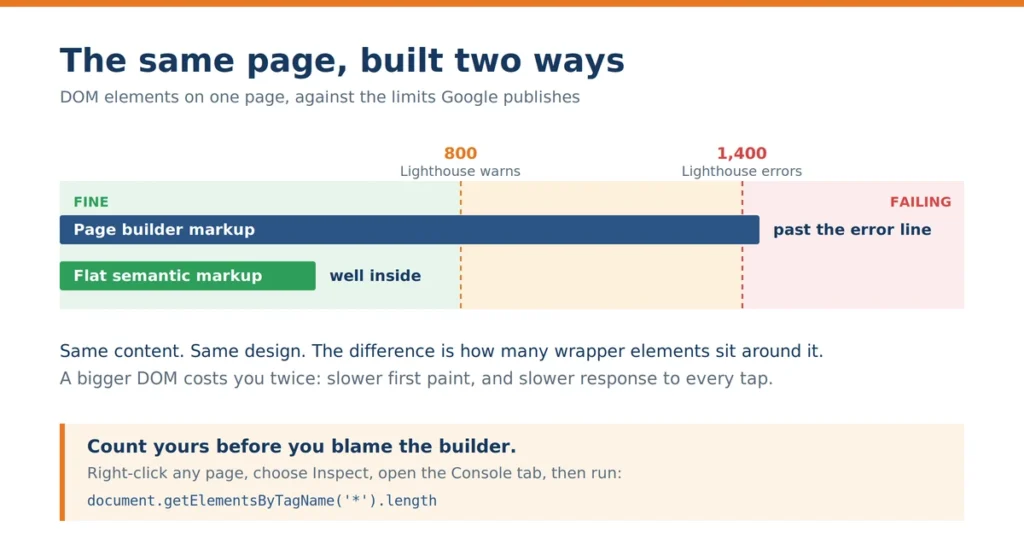
According to an independent analysis of page builder performance, Elementor loads 300 to 500KB of CSS and JavaScript by default, regardless of how much of it a given page actually uses. The same analysis documented a marketing agency’s site improving from a 5.8-second load time to 1.9 seconds after moving to a custom-built theme.
WPPoland’s benchmark comparing Gutenberg, Elementor, and Divi found a similar pattern at the markup level: an identical page rendered 356 DOM elements and 99KB of HTML in Elementor, versus 77 elements and 28KB in a leaner custom build.
None of this is one bad month. It’s a slow tax that’s easy to miss until you measure it directly.
What Going Custom Too Early Actually Costs
The reverse mistake is just as expensive, and gets talked about far less. A custom build for a business without structural complexity means paying for flexibility with no concrete use yet, then maintaining a bespoke codebase yourself instead of benefiting from a template’s shared update cycle, security patches, and plugin ecosystem.
Businesses that go custom too early often end up more locked in than the template ever made them, because now every future change requires a developer who understands a one-off codebase, not a documented platform thousands of other sites also run.
Sometimes You Don't Need a Custom Build. You Need a Better Website.
If your template still supports your operations, a thoughtful redesign can improve credibility, conversions, usability, and performance—without the cost or complexity of rebuilding from scratch. We redesign websites to support the next stage of growth while preserving the foundations that already work.

How to Actually Evaluate Whether You’ve Outgrown Your Template
Recognizing the friction is one thing. Here’s how to actually quantify it before deciding either way.
Quantify the Workaround Hours, Not Just the License Fee
Pull the last two quarters of dev and design requests, and tag every one that exists to work around something the template structurally can’t do. That number, not the annual license or hosting bill, is the real cost of staying.
Map Complexity Against Growth, Not Against Company Size
List what’s actually driving your roadmap: new customer segments, subscription tiers, regional storefronts, an LMS integration. For each, ask whether the complexity is structural (the template can’t represent it) or cosmetic (it just needs a different layout). Structural complexity is what justifies custom. Cosmetic complexity usually doesn’t.
| Staying on a template | Custom website development | |
| Cost visibility | Hidden across plugins, renewals, dev workarounds | Scoped upfront, one clear investment |
| Experimentation speed | Bounded by builder’s structure | Built around your actual customer journeys |
| Engineering time | Spent maintaining workarounds | Spent on the roadmap itself |
| Right for | Simple, linear customer journeys | Complex, multi-path operations |
When Custom Website Design Becomes the Strategic Investment
Once the audit points to structural complexity rather than cosmetic friction, custom development stops being a nice-to-have and starts being infrastructure.
When Passion 4 Pens outgrew its StoresOnline template platform, we at WisdmLabs built purpose-built migration scripts to move 36,991 customers, 1,863 products, and 8,995 orders into a custom WooCommerce setup, something a generic import tool couldn’t handle for a dataset that size.
On the elearning side, TagEvac’s fire safety training platform hit a wall its standard LearnDash group registration setup couldn’t clear: no CSV exports, no user search, no self-service resets for group leaders managing training across 127 organisations. We built custom reporting and admin plugins on top of LearnDash to close those exact gaps.
In both cases, the goal wasn’t a custom build for its own sake. It was removing a constraint that was already costing the business time.
We’ve written more on what a custom WordPress build actually involves, the specific features that only custom development can deliver, and on when a well-built theme is still the right call, because the honest answer depends on where your complexity actually sits, not on a default recommendation.
A Self-Assessment: Have You Outgrown Your Template?
Run through these honestly before committing either way:
1. Has your team quietly stopped proposing features because “the template can’t do that”? (Y/N)
2. Do your customer journeys include multiple paths, tiers, or segments the template wasn’t designed around? (Y/N)
3. Has a single integration taken multiple plugins or workarounds to function reliably? (Y/N)
4. Are dev hours spent on workarounds growing faster than hours spent on the actual roadmap? (Y/N)
5. Does your 12-month roadmap include something structurally different from what your site does today? (Y/N)
6. Have page builder plugins or updates broken something on your site in the last two quarters? (Y/N)
Four or more “yes” answers means the complexity is likely structural, and a template is probably costing you more than a custom build would. Two or fewer is a genuinely good outcome: it means your template still fits, and the money a custom build would cost is better spent on marketing, hiring, or product right now.
Conclusion
Templates and custom development aren’t really competitors. They’re tools that fit different stages of operational complexity, and the businesses that get this decision right aren’t the ones who pick a side early and defend it. They’re the ones who keep asking whether their platform matches their actual operations, not their revenue, their ambition, or what a competitor just launched.
If you’ve read this far and you’re still genuinely unsure which side you’re on, that uncertainty is itself useful information: it means you’re close enough to the line that it’s worth finding out for certain, instead of guessing either way.
Run the self-assessment above with your team this week. If it points to your template, take the money a custom build would have cost and put it into marketing, hiring, or product instead.
If it points to custom, book a free website audit with WisdmLabs and get a clear, specific answer on what your site actually needs to keep scaling, not just another opinion.
FAQ
Is custom website development always more expensive than a template long-term?
Not always. If your roadmap is mostly content and traffic growth without structural complexity, a template can remain the lower-cost option indefinitely. Custom development pays off specifically when workaround costs and lost engineering time start exceeding what a scoped custom build would cost.
How do I know if my complexity is structural or cosmetic?
Structural complexity means the template can’t represent your customer journey or business logic at all, not just that it looks generic. Cosmetic complexity is a design or layout preference the template can usually handle with configuration or a design update.
Can we start with a template and move to custom later?
Yes, and for many businesses that’s the right sequence. Starting with a template validates the business model before you invest in infrastructure built around complexity you haven’t confirmed yet.
Does custom website development mean rebuilding everything from scratch?
No. Most custom builds for growing businesses extend WordPress or WooCommerce with custom logic and integrations rather than starting over, which keeps existing content, SEO equity, and workflows intact.
How long does a custom website project typically take for a $1M+ ARR business?
Scoped custom projects for mid-market businesses typically run eight to sixteen weeks depending on integration complexity, considerably less than the years of accumulated workaround time many businesses have already spent on template friction.
Is it ever a mistake to go custom at $1M+ ARR?
Yes, when the complexity is cosmetic rather than structural. Businesses that rebuild custom because a template feels dated, without a genuine operational constraint behind it, often end up with a more expensive, harder-to-maintain version of the same site they had before.