


WordPress customization templates are pre-built themes you modify to fit your brand and business — a fast, affordable starting point that works well for many sites. But as your business grows, templates often impose limits that cost more to work around than they saved upfront: bloated code, design ceilings, update fragility, and security exposure that comes with any widely-deployed theme. Knowing which side of that line you’re on is what this article is designed to help you figure out.
In 2024, security researchers discovered 7,966 new vulnerabilities across the WordPress ecosystem — a 34% jump over the previous year, according to Patchstack’s annual security report. The majority were in plugins. But themes and templates aren’t immune — and the more widely a template is deployed, the more scrutiny it attracts from researchers and attackers alike.
That doesn’t mean templates are dangerous by default. It means that in 2026, choosing and maintaining one is a more considered decision than it used to be.
Templates have real advantages. They also have real limits. Both are worth understanding honestly before you commit to one — or decide it’s time to move past it.
First, What Do We Mean by WordPress Customization Templates?

“WordPress customization templates” covers a lot of ground. Before we get into pros and cons, it’s worth being clear about what we’re actually talking about — because not all templates behave the same way, and the category has evolved significantly in 2026.
At the simplest end, you have off-the-shelf templates: themes you install, configure through a visual customizer, and go live with minimal changes. These are the $59/year options from Astra, GeneratePress, or Kadence: lightweight, well-maintained, and built to be extended cleanly. Then there’s the middle tier: customized templates, where you take a pre-built theme and modify it more substantially, adjusting layout, adding custom functionality, overriding default styles to get it closer to what your business actually needs.
And at the other end sits fully custom WordPress development: a theme built from scratch around your specific requirements, with no pre-existing structure to work around.
Most businesses operating in 2026 sit somewhere in that middle tier. They started with a template, have customized it over time, and are now wondering whether what they’re carrying is still serving them — or holding them back.
As The White Label Agency’s breakdown of the template spectrum points out, each tier represents a different trade-off between speed and control, cost and flexibility. None of them is wrong by default. The question is whether the trade-off still makes sense for where your business is now.
The Pros of WordPress Customization Templates
Let’s start with what’s genuinely good about them. Because there’s a lot.
Pro 1 — Fast to launch, low upfront cost
This one is real and it matters. A quality premium template costs between $50 and $200. A professionally built custom WordPress theme starts around $3,000 and scales upward from there depending on complexity. For a business that’s just getting started, testing a new product line, or simply needs a professional online presence quickly, that gap is significant.
A template gets you live in days, not months. For many businesses, that speed is the right call. Getting online and generating revenue while you figure out what your site actually needs to do is often smarter than spending months specifying a custom build before you’ve learned anything from real users.
The key is knowing that “fast and affordable to start” is not the same as “cheap to maintain at scale.” Templates are a great launchpad. They’re a less great permanent foundation.
Pro 2 — A huge library of designs to start from
There are over 10,000 WordPress themes available across WordPress.org and premium marketplaces, ranging from lean, performance-focused options to richly designed multipurpose frameworks. And in 2026, the quality at the better end of that spectrum is genuinely impressive.
Lightweight themes like Astra, Kadence, and GeneratePress have matured significantly — clean code, active maintenance, strong compatibility with the block editor, and starter template libraries that give you a credible starting point for almost any type of site. Astra, for example, loads in under 1.4 seconds in standard testing with a 98% performance score, largely because its total page size sits at around 43KB.
| The block theme ecosystem deserves specific mention here. WordPress’s move toward Full Site Editing (FSE) means that well-built block themes in 2026 offer a level of visual flexibility that classic templates never could — editing headers, footers, and page templates directly in the block editor, without page builder plugins or custom code. As Brightvessel’s analysis of WordPress theme architecture changes notes, block themes are designed to benefit automatically from core WordPress improvements, while classic themes increasingly require workarounds to keep up. If you’re evaluating templates now, block themes are the honest middle ground. |
Pro 3 — Easier for non-technical owners to manage day-to-day
A well-configured template with a visual customizer means your team can update content, swap images, change text, and make basic layout adjustments without needing a developer on call. For a lean business where the owner is also managing the website, that independence is worth something real.
Page builders like Elementor and Gutenberg have made this easier still — drag-and-drop editing, live previews, and intuitive controls that don’t require any coding knowledge. The content management side of a properly set up template is genuinely good. This is one area where templates earn their reputation.
The Cons of WordPress Customization Templates
Here’s where the honest picture gets more complicated.
Con 1 — You’re bending to fit the template, not the other way around
This is the central problem with pre-built templates, and it’s been put better by the WordPress community than any agency could: as one widely-discussed analysis of WordPress template problems puts it, with a pre-built theme, “there is a mould; you must bend to fit it rather than the other way around. And that’s not how a website should operate.”
Templates are built to appeal to the widest possible audience. That’s not a criticism of the developers — it’s just the economics of selling software to thousands of different businesses. But it means every design decision, every layout assumption, every default behaviour in the template was made for a generic customer. Not for you.
The result shows up in several ways. The demo site looked exactly right — until you imported it and realised it needed $2,000 of developer time to actually look that way with your real content. The layout works well for three services but your business has seven. You spend more time working around the template’s assumptions than using its strengths.
This is also why, as we’ve written about in why off-the-shelf themes fail at scale, the limits of template-based design tend to compound as businesses grow — what felt like a small constraint at launch becomes an operational problem eighteen months later.
Con 2 — Bloated code that loads features you’ll never use
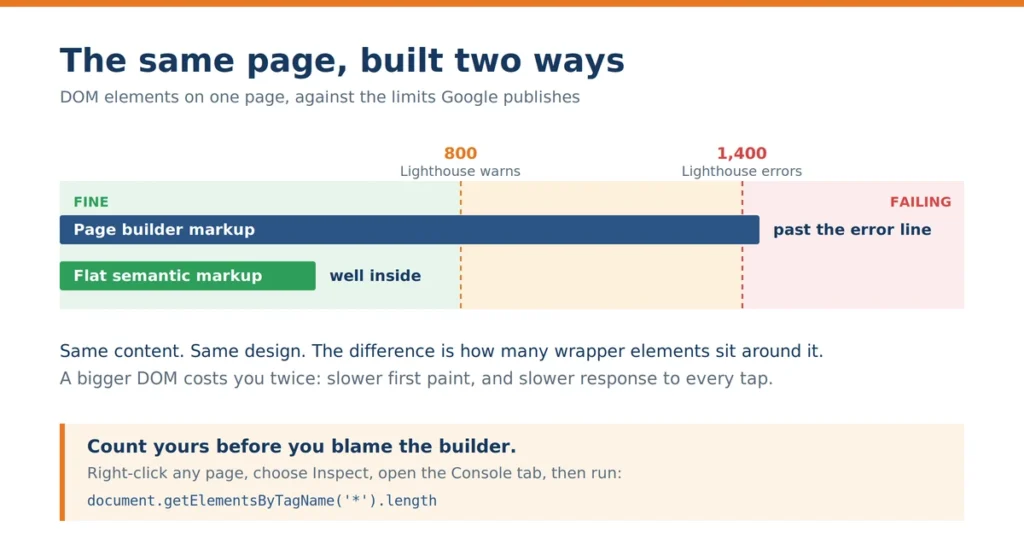
Multipurpose marketplace templates — the big sellers on ThemeForest and similar platforms — are built to do everything for everyone. Portfolio layouts, WooCommerce integration, event listings, mega menus, sliders, multiple header styles, and a dozen other feature sets are all loaded into the codebase, whether your site uses them or not.
Every page request pulls in code for functionality you’ve never activated. And your users pay the cost in load time.
Switching from a heavy template to a lean one can cut page load time by 42%, according to performance benchmarking data cited across multiple 2025 speed optimization resources. With Google’s Core Web Vitals now a direct ranking factor, that’s not a theoretical concern — it’s lost search visibility and abandoned page loads. One large media publisher found that every additional second of load time cost them 10% of their users.
We saw this play out directly in our work with Ofenakademie, where targeted speed optimization delivered a 32.5% improvement in mobile PageSpeed scores. The bloat wasn’t coming from content — it was coming from the site’s template architecture carrying features the business had never touched.
As one widely-resonated Reddit thread in the WordPress developer community put it about marketplace themes: they come with a ton of baggage because they need to cater to as many possible use cases as they can — and at some point, they become more detrimental than useful.

Con 3 — Customization creates update fragility
Here’s a dynamic that catches a lot of businesses off guard.
You customize a template to get it closer to what you need — adjusting a template file here, overriding a default style there.
For a while, everything works. Then the theme updates. And some of what you changed disappears or breaks, because updates overwrite the files your customizations were sitting in.
This is the same core-file-trap problem we described in our post on how advanced WordPress customization solves operational bottlenecks — just applied to themes instead of plugins.
The right approach exists: child themes and WordPress’s hook system let you add customizations that survive updates. But you have to know that method before you start. Most template customers don’t — and most template vendors don’t proactively explain it.
The practical result: the more you’ve customized your template, the more hesitant you become about running updates. The more hesitant you become about updates, the more security and compatibility debt accumulates quietly in the background.
Con 4 — Security exposure scales with deployment
This one deserves more attention than it typically gets. Popular marketplace templates are high-value targets precisely because of their popularity. A vulnerability in a theme with 700,000 active installations gives an attacker access to 700,000 sites simultaneously — which is why Patchstack’s 2025 security report found 7,966 new vulnerabilities across the WordPress ecosystem in 2024, a 34% increase year on year. Themes accounted for 4% of those, and more critically, over half of plugin and theme developers to whom Patchstack reported a vulnerability had not patched the issue before public disclosure.
To put that in concrete terms: Avada, one of the best-selling WordPress themes on ThemeForest, registered 18 separate vulnerabilities in December 2024 alone, according to Wordfence’s vulnerability database.
That doesn’t mean avoiding templates entirely. It means treating template maintenance as an active security responsibility rather than a set-and-forget decision. Our WordPress Vulnerability Scanner can give you a fast read on where your current setup stands.
Con 5 — Your site looks like your competitors’ sites
This one is harder to quantify, but it’s real — especially in competitive niches where your website is doing active selling work. The most popular WordPress templates are, by definition, everywhere. If you’re in eCommerce, professional services, coaching, or any sector with a lot of WordPress sites, there’s a reasonable chance your competitors have started from the same template library you have.
As a widely resonated Reddit thread in the WordPress developer community put it, templates designed to appeal to a broad audience often end up serving no one particularly well. The sites that get remembered are the ones that feel like they were built for something specific.
Generic doesn’t cost you immediately. It costs you gradually — in trust, in differentiation, in the small moments where a prospective customer compares you to a competitor and can’t quite articulate why they went the other way.
Con 6 — Switching later is more painful than starting right
This is the hidden long-term cost of a template that’s been heavily customized over time. By the time a business decides it’s outgrown its template, it’s often dealing with: overridden template files with no documentation of what was changed; a stack of plugins added to compensate for things the template couldn’t do natively; styling decisions baked into page builder shortcodes that won’t survive a theme switch; and a site that looks nothing like the original template but can’t cleanly be rebuilt without effectively starting over.
Rebuilding a heavily customized template is often more expensive than building something clean from the start would have been. It’s not a criticism of anyone who went the template route — it’s just an honest accounting of how the costs accumulate.
We’ve helped clients through this process more than once. Our Magento to WooCommerce migration for one client was completed in under a week — but that required the right team and a clear scope. The same principle applies to moving off a constrained template: it’s doable, but significantly easier when you do it before the debt has compounded.
So, when and when not to use a template?
Templates are the right call more often than custom-build advocates admit, and the wrong call more often than template sellers acknowledge. The honest answer depends on where your business actually is.

A template is probably right for you if:
• You’re launching something new, and speed to market matters more than differentiation
• Your site’s primary job is to provide basic information and a contact method
• You’re using a lightweight, actively maintained theme (Astra, Kadence, GeneratePress) — not a bloated multipurpose framework
• You have straightforward content needs that don’t require custom functionality
• Your budget genuinely can’t support a custom build right now
It’s probably time to move beyond a template if:
• Your team is doing manual workarounds each week because the template won’t do something your business needs
• Your site loads slowly and performance optimization hasn’t meaningfully helped
• You’ve tried to customize something and broken it when the theme updated
• Your site looks indistinguishable from your competitors’ — and that’s costing you
• You’re adding plugin after plugin to compensate for things the template can’t do natively
For many businesses, the ideal approach is not completely abandoning templates, but using advanced template platforms that support deeper customization workflows. Tools like WDesignKit help bridge this gap by combining 3000+ customizable and starter templates with widget builders, Gutenberg support, cloud workspace collaboration, and reusable design systems, making it easier to scale beyond basic one-click template websites.
Five quick questions to test where you stand:
1. Has your current template ever lost customizations after an update? (Y/N)
2. Are there things your site can’t do that your business actually needs — and you’ve accepted this as permanent? (Y/N)
3. Has a developer told you your theme is difficult to work with? (Y/N)
4. Do you know of at least two competitor sites using the same template as yours? (Y/N)
5. Have you added more than three plugins to make your template behave the way you need it to? (Y/N)
Score 3–5 Yes: You’ve likely outgrown your template. The question isn’t whether to move — it’s how.
Score 1–2 Yes: You’re hitting limits but not yet at a tipping point. Targeted customization may extend the life of your current setup.
Score 0: Your template is serving you well. Focus on maintaining it cleanly and keeping it updated.
If the score points toward professional help, our checklist for evaluating a WordPress development company gives you a framework for knowing what to look for before committing to anyone.
And if you’re not sure whether your template’s limitations are affecting your conversion rate specifically, the Conversion Rate Audit Tool is a useful starting point.
FAQs
Can I customize a WordPress template without coding?
For basic changes — colours, fonts, logos, layout adjustments — yes. Most modern templates include visual customizers or work with drag-and-drop builders like Elementor or the WordPress block editor, so day-to-day content management and surface-level design changes don’t require code.
Once you need to change how the template actually behaves — adding custom functionality, altering checkout flows, adjusting how data is displayed — you’ll need either code or a developer.
For a practical example of what that line looks like in practice, our guide on how to customize Contact Form 7 shows where visual customization ends and code-level changes begin.
Are WordPress customization templates good for SEO?
It depends almost entirely on which template you choose. Lightweight, well-coded themes like Astra and GeneratePress are genuinely SEO-friendly — clean markup, fast load times, Core Web Vitals compliance. Bloated multipurpose templates can actively hurt your SEO through slow load times, excessive JavaScript, and poor mobile performance.
Page speed is a confirmed ranking factor in Google’s algorithm. If you’re unsure how your current template performs, run it through Google PageSpeed Insights or GTMetrix — the score will tell you quickly whether the template is an asset or a liability.
What’s the difference between a template and a custom WordPress theme?
A template is a pre-built design someone else created for general use. You install it, configure it to fit your brand, and work within its existing structure. A custom WordPress theme is built from scratch — or from a bare framework — specifically for your business, with no pre-existing assumptions about what your site needs to do.
The practical difference is flexibility: a template has a ceiling on how far it can be taken; a custom theme has no ceiling except scope and budget. Most businesses exist somewhere between the two — a template with meaningful customization on top.
How do I know if my template is slowing my site down?
Run your site through Google PageSpeed Insights or GTMetrix and look at the “render-blocking resources” and “unused CSS/JavaScript” findings. If you’re seeing large amounts of JavaScript or CSS flagged as unused, that’s typically template bloat — code loaded on every page for features your site doesn’t use.
A score below 70 on mobile is a meaningful signal that the template’s performance overhead is hurting you. If you want a broader security and performance read, our WordPress Vulnerability Scanner covers the security side of the same question.
When should I hire a custom web development agency instead of using a template?
When the gap between what your template does and what your business needs costs more in workarounds, developer patches, and lost performance than a clean build would have. That tipping point is different for every business — it depends on what your site needs to do, how competitive your market is, and how much technical debt has accumulated.
A straightforward way to tell: if you’ve spent significant developer time on your template in the last twelve months without fundamentally improving what it does, you’re probably past the point where extending it makes financial sense.
Most businesses start with a template. That’s not a mistake — it’s a reasonable, practical decision. The mistake is staying on one after it’s stopped being a starting point and become a constraint.
If you’re at that point — or starting to suspect you are — here’s how we at WisdmLabs approach it:
- A 30-minute call. We find out what your site needs to do, where the template is getting in the way, and whether the right move is targeted customization or a clean build. No deck. No upsell.
- A clear scope. Before any work starts, you know exactly what the solution involves, how long it takes, and what it costs. In plain language.
- We build it. WisdmLabs handles the technical work. You stay involved where your input matters — and not in every decision that doesn’t need you.
- You test it, we launch it. Nothing touches your live site until you’ve reviewed it on a staging environment and signed off.
- You own it. Everything is documented and handed over. No dependency on us to keep it running — unless you want ongoing support.