
| Quick Answer: In the USA, hiring a WordPress developer can cost anywhere from $20 to $250+ per hour, but the right budget depends more on project complexity, hiring model, and required expertise than on hourly rate alone. Entry-level freelancers start around $20–$50/hour, mid-level developers charge $50–$100/hour, and senior specialists command $100–$250+/hour. For project-based work, expect $500–$4,000 for a basic business site and $5,000–$50,000+ for complex e-commerce or custom builds. The real cost depends on project complexity, the hiring model you choose (freelancer vs. agency vs. retainer), and whether you factor in hidden costs like premium plugins, hosting, and ongoing maintenance. |
If you’re planning to build or scale a website in 2026 and wondering how much does it cost to hire a WordPress developer, you’re not alone in this dilemma. With WordPress powering over 43% of all websites globally, finding the right developer at the right price has become… well, let’s just say it’s gotten complicated.
Here’s the thing though – and this might surprise you – the cost varies so wildly that you could end up paying anywhere from $20 to $250 per hour. But don’t panic just yet.
I’m going to break down exactly what you should expect to pay in 2026, and more importantly, how to figure out what type of developer you actually need.
Also Read: Why a Custom WordPress Website Is a Business Asset
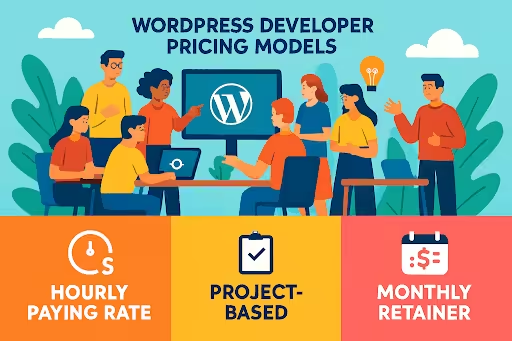
WordPress Developer Pricing Models
Let’s take a step back before talking costs. All WordPress developers don’t charge the same way – most follow one of three standard pricing methods. The tricky part?
Each developer cost approach has its own set of good things and bad things. If you make your choice poorly, it could cost your business more money in the long run.
👉Hourly Pricing
It is probably the most common approach you’ll encounter. It’s straightforward – you pay for the time they spend working on your project. The rates vary quite a bit depending on experience level:
| Experience Level | Hourly Rate (USA) | What You Get |
| Entry-level (0–2 years) | $20–$50 | Basic setups, theme installations, simple customizations |
| Mid-level (2–5 years) | $50–$100 | Custom themes, plugin integrations, WooCommerce stores |
| Senior (5+ years) | $100–$200+ | Complex architecture, performance optimization, security hardening |
| Specialized experts | $150–$300+ | WooCommerce at scale, headless WordPress, API integrations, AI implementations |
Best for: Projects where the scope may evolve, or when you need ongoing tweaks and maintenance.
Watch out for: Without clear boundaries and time estimates, costs can escalate quickly. Always agree on a maximum hours cap and request weekly time reports.
The hourly pricing model is useful when your WordPress development project scope changes over period of time, or you will need ongoing tweaks and maintenance as the development progresses.
But here’s what I’ve learned – if you fail to set clear boundaries, the cost is expected to sky-rocket pretty quickly.
Also Read: How a Custom WordPress Website Development Company Really Works
👉Project-Based Pricing
It gives you more predictability in terms of budget allocation. The WordPress developer will quote a fixed fee for the entire project for you to factor into your business cost.
This acts as a relief if you’re working with a tight budget. However, if it so happens that your WordPress development requirements change mid-project, you might end up paying extra to the developer. According to recent research data, below is a summary of the amount that you’re looking at:
- Basic 5-page website: $500-$2,000 (freelancer) / $2,000-$4,000 (agency)
- Custom business website: $2,000-$5,000 (freelancer) / $5,000-$10,000 (agency)
- WooCommerce store: $5,000-$10,000 (freelancer) / $8,000-$25,000 (agency)
- Custom plugin development: $800-$2,500 (freelancer) / $3,000-$10,000 (agency)
Best for: Well-defined projects with clear requirements.
Watch out for: If requirements change mid-project (and they often do), you will negotiate change orders — which can be contentious and expensive.
👉Monthly Retainers
These are becoming increasingly popular, especially for businesses that need ongoing support. The best of having a monthly retainer is their availability at the click of few buttons as and when the requirement arises.
- Basic retainers ($500-$2,000/month): Regular updates, security monitoring, minor content changes.
- Advanced retainers ($2,000-$5,000+/month): Continuous development, performance optimization, strategic improvements.
We’re seeing more businesses move to retainers because it’s predictable and ensures your site gets consistent attention rather than being neglected until something breaks.
Best for: Businesses that need ongoing attention — e-commerce stores, membership sites, content-heavy sites.
Watch out for: You pay whether you use the full allocation or not. Negotiate rollover clauses so unused hours carry forward for 1–2 months.
Want a clearer estimate before starting? Use an App Cost Calculator to get a quick idea of your project’s pricing range.
An App Cost Calculator helps you compare development costs, features, and timelines — saving time and budget surprises later.
| AI-Powered Tip: Use ChatGPT or Claude to draft a clear project brief before requesting quotes. A well-defined brief helps developers estimate more accurately and prevents scope creep. Try this prompt: “I need a project brief for a WordPress website. The site is for [business type], needs [key features like WooCommerce, membership, booking system], targets [audience], and should integrate with [tools like Mailchimp, Stripe, HubSpot]. Write a structured brief I can send to developers for accurate quotes.” |
What affects WordPress developer pricing?
| Factor | How it affects cost |
|---|---|
| Project complexity | More custom functionality usually means more hours and deeper expertise |
| Experience level | Senior developers charge more but often solve problems faster |
| Hiring model | Freelancers, agencies, and retainers all price differently |
| Urgency | Rush work usually increases rates |
| Custom integrations | APIs, CRMs, payment flows, and automations raise complexity |
| Ongoing support | Maintenance and long-term optimization add recurring cost |
Also Read: 7 Ways Design–Development Misalignment Breaks WordPress Websites
Cost Breakdown by Experience Level
Imagine hiring a painter. One charges $200 for a room. Another quote $1,000.
Are they both wrong? Not really. One brings a brush, the other brings a team, guarantees quality, and fixes mistakes for free.
Thus, here’s where things get interesting. The experience level of your developer dramatically impacts what you’ll pay, and for good reason.
| Basis for comparison | Entry-Level Developer | Mid-Level Developer | Senior Developer |
| Hourly Rate | $20 – $50 | $50 – $100 | $100 – $200+ |
| Years of Experience | 0 – 2 years | 2 – 5 years | 5+ years |
| Project Complexity | Basic WordPress setups, simple site customizations and small fixes | Medium complexity projects, custom themes, plugin development and integrations | Architectural thinking, complex builds, large-scale projects, security and high-performance needs |
| Typical Project Timeline | 25% longer than mid-level (need supervision) | Standard timeline (2-4 weeks for medium sites) | Often faster completion despite higher rates |
| Supervision Requirement | High – need more guidance and oversight | Moderate – can work independently on most tasks | Minimal – self-directed and mentor others |
| Strengths | Affordable, enthusiastic, adaptable, can grow with your project | Balanced skills, reliable delivery, fewer mistakes, independent work | Expert-level coding, speed, security, scalability, minimal supervision |
| Risks / Limitations | Slower on complex tasks, higher chance of errors | May still struggle with highly complex architectures or scaling | Higher upfront cost, availability may be limited |
| Project Fit Examples | Personal blogs, small business sites, theme tweaks | E-commerce sites, membership portals, corporate websites | SaaS platforms, enterprise sites, projects needing security & performance |
| Value for Money | 💲💲💲 (Low cost, but time trade-off) | 💲💲 (Best cost-to-quality ratio) | 💲 (High cost, but long-term savings due to speed & fewer fixes) |
💯 Key Insights:
👉 Cost vs. Speed Trade-off: Senior developers charge more but often finish faster, reducing total project cost difference.
👉 Risk Factor: Entry-level developers may introduce risks if project complexity is underestimated.
👉 Sweet Spot: Mid-level developers are ideal for most businesses needing quality without premium costs.
Also Read: Why Businesses Are Choosing WordPress Monthly Retainers in 2026
Freelancer vs Agency vs Retainer Pricing
This is probably one of the biggest decisions you’ll make, and the cost difference is significant. It’s not just about what you need built – it’s about how you want it built and supported.

✍️ Freelancer Pricing
Freelancers are the go-to choice for startups, bloggers, and small businesses. They’re flexible, usually cheaper, and you get direct communication.
| Strengths: Lower cost, flexibility, direct relationship, faster decision-making. Trade-offs: Single point of failure — if your freelancer is unavailable, your project stalls. Limited capacity for large or multi-disciplinary projects. |
Freelancers generally offer more competitive rates because they don’t have the overhead of an agency. You’re looking at roughly 20-40% less than agency rates. The cost also depends on the level of experience of the freelances:
👉 Entry-Level Freelancers ($20-$50/hour)
The WordPress developers may be fresher without industry experience or those with 1-2 years of experience. Such developers are great for the basic tasks related to your website such as web-theme setup, installation of plugin, or simple content updates on your website.
For such developers, you will have to invest your time in terms of providing guidance. These developers are able to handle simple web design and management projects quite well and efficiently.
👉 Mid-Level Freelancers ($50-$100/hour)
This is honestly the sweet spot for most small to medium businesses. These developers can handle customizations, performance optimization, and site architecture.
These freelances have enough experience in their portfolio to work independently with minimum instructions; however they are yet to reach premium pricing for their models.
👉 Senior Freelancers ($100-$200+/hour)
Seasoned freelancers are like the cheat codes of the gaming. These folks don’t just toss together basic stuff—they can whip up custom, scalable systems, code up plugins out of thin air, and wrestle even the messiest APIs into submission.
They move quick, but they’re not just sprinting for the finish line – they actually think ahead, which saves you headaches down the road. Plus, they’ve seen so many weird tech problems, nothing really fazes them anymore. That higher hourly rate? Yeah, totally worth it when you realize how much chaos they save you from.
The downside to hiring freelancer? If your freelancer is unwell or works with multiple projects, your business timelines may take a hit.
Related Read: Hiring a WordPress developer vs. DIY: What Really Helps Your Business Grow?
✍️ Agency Pricing
Agencies operate differently. They offer full-stack services: design, development, SEO, security, maintenance – all in one package.
Agencies typically charge 50-100% more than freelancers, but you’re paying for a team, project management, and backup resources.
🤑 Hourly rates (USA): $75 – $200/hour
🤑 Project-based pricing: Anywhere between $5,000 – $50,000+
| Strengths: Team backup, project management, broader skill sets, guaranteed availability. Trade-offs: Significantly higher cost. You are paying for infrastructure, coordination, and redundancy — valuable for complex projects, but overkill for simple ones. |
Also, these prices are not fixed and vary largely depending on the quality of services rendered by them:
👉 Standard Agencies ($100-$150/hour)
These agencies typically have 5-15 people and can handle most business websites professionally. With these agencies, you will get combination of project manager, web designers, WordPress developers, and QA testing, all things packed together in one bundle.
👉 Premium Agencies ($150-$300+/hour)
These heavy-hitter agencies? They are all about working giant enterprise gigs or those tricky, “oh no, what have we gotten ourselves into” projects that need both wild creativity and some serious technical wizardry.
Got some too technical web design headache or a plugin dream that’s way off the beaten path? These folks can untangle it for you at no sweat.
The main advantage when you hire professional WordPress developer teams through agencies is that they can handle larger, more complex projects and provide comprehensive support. The downside? You’re definitely paying a premium for that service., you’re getting specialized skills.
✍️ Retainer Pricing
Honestly, retainers are the sweet spot when you’re juggling freelancers and agencies. Instead of coughing up cash for every little project, you just pay a set fee each month and, boom, you’ve got someone on call for whatever pops up—website tweaks, security stuff, random fixes. Way less hassle.
And let’s be real, everybody’s is offering retainers now in 2026. Can you blame them? If your website needs TLC on the regular – patches, tweaks, chasing down those weird bugs – why start from scratch every single time? Just sign the deal with a single developer and stop sweating the small stuff.
Go and work towards building your business.
👉 Freelancer Retainers: $500 – $2,000/month
- Basic maintenance, content updates, minor customizations
- Direct communication with your dedicated developer
- More flexible and personal service
👉 Agency Retainers: $1,500 – $8,000+/month
- Comprehensive service including design, development, SEO, security
- Access to specialized team members as needed
- Project management and strategic guidance included
The main advantage of retainers is predictable costs and priority access to your developer or team. You’re essentially “reserving” their time each month, which means faster turnaround when you need updates or fixes.
The downside? You’re paying whether you use the full allocation or not. However if you negotiate well during finalization of work agreement, most retainers will agree to roll over of unused time slot for 1-2 months. This makes them more flexible when compared with agency developers.
Freelancer vs agency vs specialist platform
| Option | Best for | Main advantage | Main trade-off |
|---|---|---|---|
| Freelancer | Small to mid-sized projects | Lower cost, direct communication | Less backup if unavailable |
| Agency | Complex or business-critical projects | Full team support, better process | Higher cost |
| Specialist platform | Businesses wanting vetted WordPress experts | Better quality control | Higher rates than general marketplaces |
Geographic Cost Variations
It doesn’t matter which location your belong too. In today’s digital world, you might be sitting in London working with a developer in Australia. However, due to the cost variations, location still matters in our remote-first world. Here’s what developers charge in different regions:
- North America: $60-$200+ per hour
- Western Europe: $50-$150 per hour
- Eastern Europe: $30-$80 per hour
- Asia (India, Philippines): $15-$60 per hour
- Latin America: $25-$70 per hour
The quality isn’t necessarily tied to the location, though. I’ve seen excellent work from developers in all these regions.
Factors That Impact Developer Costs
Not all WordPress projects are created equal. Several factors can push your costs to hire professional WordPress developer up or down and understanding these costs can help you budget more accurately in your business.
👉 Project Complexity: Let’s be real – how complicated your project is? Yeah, that’s will decide the price tag for your website, big time. Like, tossing up a basic “look at my business” site? That’s a simple task compared to, say, building a whole custom membership portal or a monster eCommerce shop with bells, whistles, and confetti.
- Simple Projects typically include:
- Basic theme customization
- Standard plugins
- Simple contact forms
- Basic SEO setup
- Complex Projects might involve:
- Custom plugin development
- API integrations
- Advanced user management
- Complex workflows and automation
👉 Speed and urgency: Rush projects requiring developers to work on a tight deadline will often cost more than those with flexible timelines.
👉 Specialized Skills: Developers with expertise in high-demand areas like custom WooCommerce solutions, headless WordPress, API integrations, or performance optimization command higher rates.
👉 Performance and Security Requirements: If your site needs to handle high traffic, requires advanced security measures, or needs to meet specific compliance standards, expect higher development costs.
Hidden Costs to Consider
This is where many people get caught off guard. Beyond the developer’s fee, adding ecommerce, custom plugins, or advanced integrations can double (sometimes triple) your budget:

👉 Premium themes and plugins: $50-$500 annually per plugin. It will burn your pockets faster than you think.
👉 Hosting and domain: $60-$1,200 annually depending upon your website growth and requirements.
👉 SSL certificates and security: $50-$500+ annually depending on the advanced security measures, premium security plugins and monitoring services you are deploying for your website.
👉 Ongoing maintenance: $100-$500 monthly for professional maintenance depending on your website’s complexity.
| AI-Powered Tip: Use AI to estimate your total project cost before approaching developers. Try this prompt: “I’m building a WooCommerce store with 500 products, Stripe payments, shipping calculator, and Mailchimp integration. Estimate the full first-year cost including development, hosting, essential plugins, and ongoing maintenance. Break it down by category.” |
Common mistakes that lead to overspending
| Mistake | Why it is risky |
|---|---|
| Choosing only by hourly rate | Cheap rates can hide slow work or rework |
| Poorly defined scope | Causes budget drift and revision issues |
| Hiring senior talent for basic tasks | You may overpay for simple work |
| Ignoring maintenance costs | The site becomes expensive later |
| Overlooking communication quality | Delays and misunderstandings increase cost |
How to Choose the Right WordPress Developer
You know, the absolute cheapest option isn’t always the smartest investment. I’ve definitely seen way too many businesses end up spending way more money later on just to fix issues that could have been avoided by hiring a qualified developer from the start.
When you’re looking hire professional WordPress developers, focus on people who have practical real life work that actually relates to what you need. Good communication is huge, and so are realistic timelines.
And if you’re hiring a pro WordPress developer, definitely make sure to ask them about their experience with projects similar to yours.

Below are some factors for you to consider to consider when deciding to hire a WordPress developer:
Step 1: Define your requirements clearly. Vague requests get vague quotes. Write down every feature, integration, and page you need. Use AI to help draft a comprehensive brief.
Step 2: Match complexity to skill level. Simple site? Mid-level freelancer. Complex e-commerce? Senior developer or agency. Do not overpay for a senior developer to install a theme, and do not underpay for a junior to build a custom application.
Step 3: Get 3–4 quotes and compare scope, not just price. The cheapest quote often excludes testing, security, SEO setup, or post-launch support. Compare what is included.
Step 4: Check their work, not just their words. Open their portfolio sites and test them — run PageSpeed Insights, check mobile responsiveness, try the checkout flow. This tells you more than any sales pitch.
Step 5: Start small. If possible, begin with a smaller project or paid test task before committing to a large engagement. This reveals their actual work quality, communication style, and reliability.Step 6: Think long-term. Factor in maintenance, updates, and future feature additions. A developer who charges more upfront but offers ongoing support and writes clean, maintainable code will cost you less over 2–3 years than a cheap build that needs constant fixing.
| Golden Tip: Seek out developers who have a portfolio showcasing relevant work, communicate clearly, and offer practical timelines. When you’re considering professional WordPress talent, be sure to ask them about their experience with projects similar to yours. |
Cost Comparison of WordPress Developer
Lots of things to grasp and understand how much does it cost to hire WordPress developer? Well, here is quick comparison table for you to make your decision:
| Developer Type | Hourly Rate (USD) | Project Cost Range | Best For |
| Entry-Level Freelancer | $20 – $50 | $500 – $2,500 | Simple websites, basic customization |
| Mid-Level Freelancer | $50 – $100 | $2,500 – $10,000 | Business sites, moderate complexity |
| Senior Freelancer | $100 – $200+ | $10,000 – $50,000+ | Complex custom development |
| Junior Agency Developer | $40 – $75 | $2,000 – $5,000 | Small business websites |
| Mid-Level Agency Developer | $75 – $150 | $5,000 – $25,000 | E-commerce, custom features |
| Senior Agency Developer | $150 – $250+ | $25,000 – $100,000+ | Enterprise solutions |
Conclusion
So, how much does it cost to hire a WordPress developer in 2026? The honest answer is: it depends on what you need and who you hire. Entry-level freelancers start around $20/hour, while senior agency developers can charge $250+ per hour.
But here’s what I’ve learned after years in this industry – don’t just focus on the hourly rate. A senior developer who charges $150/hour but finishes in 20 hours often costs less than a junior developer charging $30/hour who takes 80 hours to complete the same project.

The key is matching your project needs with the right developer level. Simple site? Entry-level might be perfect. Complex e-commerce platform? You’ll want senior expertise. And if uptime and updates are mission-critical, a retainer will save you headaches.
When you’re ready to hire professional WordPress developer services, spend time clearly defining your requirements, get multiple quotes, and don’t be afraid to ask questions about their approach and timeline.
Remember! No one loves overspending, but under-investing in your website? That usually costs more in the long run.
| Top 5 cost drivers for WordPress development? 1. More complex functionality Stores, LMS platforms, memberships, and multilingual sites cost more than basic brochure sites. 2. Custom development Custom plugins, APIs, dashboards, and workflows add time and expertise. 3. Performance and security requirements Faster, safer, more scalable builds usually need senior-level work. 4. Urgent timelines Faster delivery often comes with premium pricing. 5. Post-launch support Maintenance, improvements, and troubleshooting add recurring costs. |
Also Read: The Future of SEO: Why Every WordPress Developer Needs an AI-Driven SEO Course
Frequently Asked Questions
❓ What’s the average cost to hire a WordPress developer in the USA??
WordPress developer costs in the USA typically range from $30-$200+ per hour, with most mid-level developers charging $50-$100 per hour. Project costs range from $500 for basic sites to $30,000+ for complex custom solutions.
❓ What’s the difference between hiring a freelancer vs an agency?
Freelancers typically cost 20-40% less but offer limited backup if they’re unavailable. Agencies cost more but provide teams, project management, and guaranteed availability.
If budget and flexibility matter, start with a freelancer. If reliability and scale are priorities, agencies are worth the extra cost.
❓ Is it cheaper to hire developers from other countries?
Generally yes – developers in Asia charge $15-$60/hour compared to $60-$200+ in North America. However, communication, time zone differences, and quality consistency can be challenges.
❓ How much should I budget for a basic business website?
For a basic 5-page business website, budget $500-$2,000 with a freelancer or $2,000-$4,000 with an agency.
❓ How long does it take to build a WordPress website?
Simple sites take 1-4 weeks, business sites take 4-8 weeks, and complex e-commerce sites can take 8-16 weeks or more. Don’t forget that timeline affects cost, as rushed projects often demands premium rates.
❓What factors affect WordPress development costs the most?
The biggest cost factors are project complexity, developer experience level, custom vs template design, required integrations, and geographic location. Complex eCommerce sites or custom plugin development cost significantly more than basic business websites.
❓ What questions should I ask before hiring a WordPress developer?
Ask about their experience with similar projects, their development process, timeline estimates, what’s included in their quote, and their approach to testing and security.
❓ Should I pay the full amount upfront?
No, reputable developers typically ask for 25-50% upfront, with the remainder paid in milestones or upon completion.
❓ How do I avoid being overcharged?
Get multiple quotes, ask for detailed proposals, and don’t just pick the cheapest. Cheap can get very expensive when things break.
❓ Do retainers make sense for small businesses?
Not always. If you only update your site once a month, a retainer may not be worth it. Pay per project or maintenance package instead.
❓Do I need to pay for ongoing maintenance?
Yes, WordPress sites need regular updates, security monitoring, and backups. Budget $100-$500 monthly depending on your site’s complexity.